A nickel and a five-dollar bill, same feature name
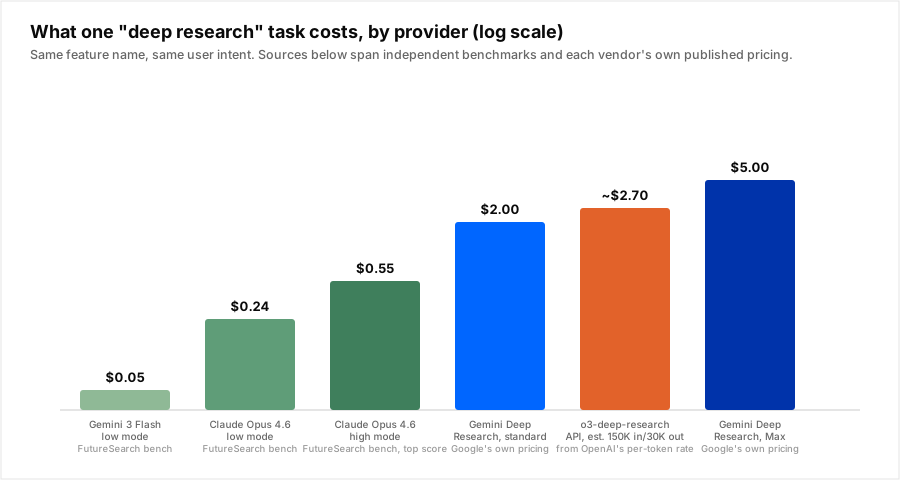
Every major AI product shipped a "Deep Research" button in the last eighteen months, and every one of them is a different price. FutureSearch's independent benchmark of 20-plus research agents put Gemini 3 Flash in low mode at $0.05 a task, and Claude Opus 4.6 at $0.24 in low mode and $0.55 in high mode, the setting that topped its accuracy leaderboard. Source: FutureSearch, "How Much Does Deep Research Cost? A Model-by-Model Breakdown," February 12, 2026, updated March 30, 2026. Google's own published pricing for its Deep Research agent, launched on the Gemini API on April 21, 2026, lands at roughly $2 a task in standard mode and $5 in Max mode. Source: Google AI for Developers, "Deep Research preview" and "Deep Research Max preview" model docs. OpenAI's o3-deep-research API bills separately from any of that, at $10 per million input tokens and $40 per million output. Source: PricePerToken, o3-deep-research API pricing page.
Run the arithmetic on a single task that reads 150,000 tokens of search results and writes a 30,000-token report, well inside the range these agents are reported to run, and o3-deep-research lands around $2.70, before the search calls that fill that context are even counted. Four vendors, one feature category, a spread from five cents to five dollars for what a user experiences as the same click. Nobody publishes what decided which price the user's specific question was worth. Nothing did. The toggle is manual.
What "deep research" actually spends the tokens on
A normal chat completion is one prompt and one response. Deep research is an agentic loop: the model plans a research strategy, fires off a batch of search queries, reads and summarizes what comes back, decides whether it has enough to answer or needs another pass, and only then writes the final report. Google's own numbers show why that loop costs what it costs: a standard task runs about 80 Google Search queries at $14 per 1,000, adding $1.12 in search cost on top of inference, and a Max task runs 160 queries, adding $2.24. Source: Google AI for Developers, Deep Research agent documentation, and TokenCost, "Gemini Deep Research pricing: cost per task," 2026. Implicit caching covers an estimated 50 to 70 percent of the input tokens in a task, which is the only reason the inference half of the bill stays as low as it does. Source: TokenCost, "Gemini Deep Research pricing: cost per task". Independent industry write-ups of the category put the token multiplier plainly: a deep research run typically burns on the order of 10x the tokens of a normal chat turn, because it's paying for the search fan-out and the synthesis pass, not just the answer. Source: AnswerRocket, "Deep Research: What It Is, How It Works, and Why It Matters".
None of that is a defect. A genuinely open-ended research question — competitive landscape, literature review, multi-source due diligence — needs the fan-out, and DeepResearch Bench, a 100-task benchmark spanning 22 fields built by 100-plus domain experts, exists specifically because a single-pass chat answer measurably under-serves that kind of question. Source: DeepResearch Bench, "A Comprehensive Benchmark for Deep Research Agents". The problem is that the same button sits in front of "what's our Q3 competitor pricing" and "what's the capital of France," and the product has no mechanism between the click and the $2 to $5 charge that checks which one it's looking at.
Provider | est. cost/task | mechanism | who decides
| Provider | Est. cost per task | How the loop is priced | What gates the spend |
|---|---|---|---|
| Gemini 3 Flash, low mode | $0.05 | Standard token rate, minimal search fan-out | User picks "low" manually |
| Claude Opus 4.6, low / high | $0.24 / $0.55 | Standard token rate, fan-out scales with mode | User picks the mode manually |
| Gemini Deep Research, standard | ~$2.00 | Gemini 3.1 Pro rate + 80 search queries at $14/1K | User clicks "Deep Research," not "Ask" |
| o3-deep-research API | ~$2.70 (est.) | $10/M input, $40/M output, plus search | Developer sets the model per call |
| Gemini Deep Research, Max | ~$5.00 | Gemini 3.1 Pro rate + 160 search queries at $14/1K | User clicks "Max," not "standard" |
Every row in that table is gated by a human picking a mode before the model sees the question. None of them are gated by what the question actually needs.
The only automated control that ships today is a quota, not a router
OpenAI's own answer to the cost problem is the closest thing to automation in the category, and it's instructive precisely because of what it isn't. ChatGPT Plus, Team, and Enterprise users get 25 deep research queries a month; once that allotment is gone, further requests silently fall back to a lightweight version of the tool powered by o4-mini instead of o3. Source: Wikipedia, "ChatGPT Deep Research," citing OpenAI's release notes. That is a real cost control, and it works, in the sense that it caps what OpenAI pays to serve any one account. But look at what it's actually keyed on: a running counter of how many times this account has clicked the button this month, not whether the 26th question was a two-hop lookup or a genuine multi-source investigation. A trivial question asked as query #3 gets the full o3 treatment. A hard question asked as query #26 gets downgraded to the lightweight model regardless of what it needed. The gate is calendar-based, not content-based.
That's the same shape of gap spend-threshold alerts and token-based credit pricing left open four days apart in Claude Enterprise and ChatGPT Enterprise this month: a control that fires after the fact, or on a schedule, instead of one that looks at the specific request in front of it. It's also the same gap multi-agent orchestration frameworks leave open when they route every subagent at the orchestrator's rate — a deep research loop is a multi-agent system by another name, a planner fanning work out to search-and-summarize steps, and almost none of those steps individually need the frontier model driving the whole loop.
What actually closes the gap
- Classify before you fan out, not after. A router that scores the incoming question — single fact lookup versus open-ended multi-source synthesis — before deciding whether to invoke the full research loop is a strictly better gate than a monthly counter, because it looks at the thing that actually determines cost: what the question needs, not when it was asked. The same conjunctive-fit logic that decides whether a chat request needs a frontier model instead of a cheaper one applies directly here: does this specific request clear the bar for the expensive path, or doesn't it.
- Route the loop's own sub-steps, not just the entry point. Planning the research strategy and writing the final synthesis are the two steps that plausibly need frontier reasoning. Summarizing an individual search result into three bullet points, the step that runs 80 to 160 times per task, almost never does. Every subagent call in a fan-out architecture is a separate routing decision, and pricing the whole loop at the orchestrator's rate is where the multiplier actually comes from.
- Cache the sub-queries, not just the final report. Enterprise research tasks overlap constantly — "current competitor pricing," "latest quarterly guidance," "regulatory status in the EU" get asked by a dozen different analysts across a dozen different reports in the same month. A semantic cache on the search-and-summarize sub-calls, not just the final answer, turns the second and twelfth version of that sub-question into a cache hit instead of another $1.12 to $2.24 in search cost. The same caching layer that turns a repeated retrieval pass in a RAG pipeline into a near-zero-cost hit applies to the overlapping sub-questions inside a research loop.
- Score the report before you bill for the mode. The DeepResearch Bench team's own judge-cost breakdown shows that grading a research report runs $0.04 to $0.47 depending on which model does the grading, which is the same eval-tax problem in miniature: the check on the output is itself a routing decision, and running it on the cheapest model that can actually judge correctly is the same fix that already applies to the traffic the eval exists to grade.
What that looks like in a request
None of the above requires replacing the research agent. It requires putting a router in front of the calls the loop already makes:
import openai

client = openai.OpenAI(
    base_url="https://api.getnadir.com/v1",
    api_key="ndr_...",
)

# Planning and final synthesis are the two steps in a research loop
# that plausibly need frontier reasoning. Every per-source summarization
# call in between goes through the same endpoint, scored independently —
# most of them don't clear the bar for the model driving the whole loop.
response = client.chat.completions.create(
    model="auto",
    messages=[{"role": "user", "content": summarize_source_prompt}],
)
Same call shape as talking to any OpenAI-compatible endpoint, no change to the loop's control flow. Nadir scores each sub-call against the cheapest model that can handle it, reports cache hit status per request in the response metadata, and shows the delta against always-frontier on the savings dashboard, so the loop that fans out 80 to 160 times a task stops paying frontier rates on the summarization step just because the planning step needed it.
What to ship this week
- Instrument the toggle. Log whether a deep research click was followed by a question a single-pass answer would have handled correctly. If you don't know your overkill rate, you can't fix it.
- Default the mode off for lookup-shaped questions. A question with one clear answerable fact doesn't need 80 search queries to confirm it. Gate the expensive mode behind a classifier, not a button everyone reaches for out of habit.
- Cache across users, not just across turns. If ten analysts on the same team are researching overlapping questions this quarter, the tenth one shouldn't be paying full search cost for a sub-question the second one already answered.
- Route the loop's interior, not just its entry point. The planning call and the synthesis call are worth scrutinizing individually. The 80 to 160 summarization calls in between are worth routing by default.
Conclusion
The five-to-a-hundred-fold spread in what "deep research" costs across providers isn't really a pricing story. It's a routing gap wearing a pricing story's clothes. Every vendor in the category built a genuinely more capable research loop, gated it behind a manual mode switch or a monthly counter, and left the actual decision, does this specific question need this specific loop, to a user clicking a button before the model ever sees the question. A router that looks at the request instead of the account's usage history is a strictly better gate, and it's the same mechanism that already works on the traffic that never had a "Deep Research" label on it in the first place.
Related reading
- Anthropic gave admins spend alerts. OpenAI moved to token-based credits. Neither one changes what the next request costs.
- Multi-agent AI costs 15x more, and almost nobody routes it.
- The Eval Tax: benchmarking your agent now costs more than running it.
- RAG's real cost isn't retrieval, it's over-retrieval.
- The LLM router that refuses to guess, and cuts bad routes 23%.
Sources: [FutureSearch, "How Much Does Deep Research Cost? A Model-by-Model Breakdown," February 12, 2026, updated March 30, 2026](https://futuresearch.ai/blog/cost-of-deep-research/). [Google AI for Developers, "Deep Research preview" / "Deep Research Max preview" model documentation](https://ai.google.dev/gemini-api/docs/models/deep-research-preview-04-2026). [TokenCost, "Gemini Deep Research pricing: cost per task," 2026](https://tokencost.app/blog/gemini-deep-research-agent-cost). [PricePerToken, o3-deep-research API pricing page](https://pricepertoken.com/pricing-page/model/openai-o3-deep-research). [Wikipedia, "ChatGPT Deep Research," citing OpenAI release notes](https://en.wikipedia.org/wiki/ChatGPT_Deep_Research). [DeepResearch Bench, "A Comprehensive Benchmark for Deep Research Agents"](https://deepresearch-bench.github.io/). [AnswerRocket, "Deep Research: What It Is, How It Works, and Why It Matters"](https://answerrocket.com/deep-research-what-it-is-how-it-works-and-why-it-matters/). Illustrative cost figures marked "est." are back-of-envelope calculations from each vendor's own published per-token or per-query rates, not independently measured production traces.