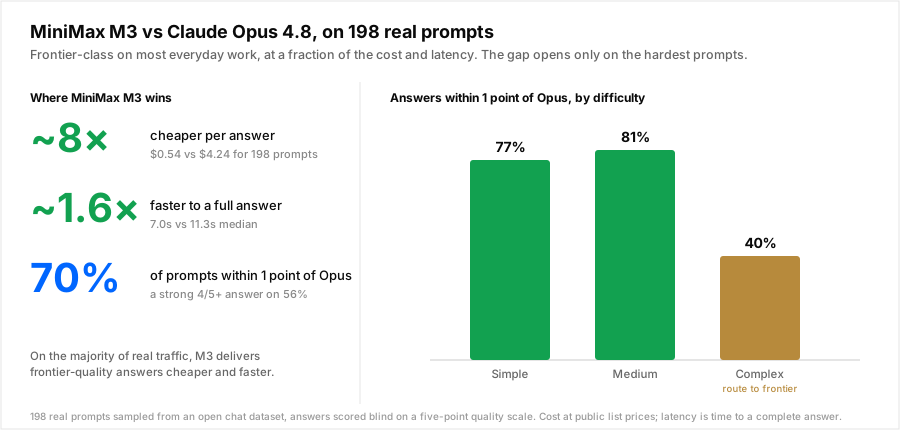
MiniMax M3 costs about a tenth of Claude Opus 4.8 per token, so we ran both on 198 real prompts and measured cost, accuracy, error rate, and speed. MiniMax came out about 8x cheaper per answer and roughly 1.6x faster, and it matched Opus within a point on 70% of prompts. The catch is the tail: 27% of its answers came back clearly worse, rising to 58% on the hardest prompts, so a blanket swap is a real quality risk on hard work.
Published 2026-07-09 by Dor Amir on the Nadir blog.
MiniMax M3 lists at roughly one tenth of Claude Opus 4.8's price per token, so the question every team asks is simple: if you send your traffic to the cheaper model, what do you actually give up? We ran both models on 198 real user prompts and measured the four things that matter in production, cost savings, accuracy, error rate, and speed. Here is what we found.
Metric
MiniMax M3 vs Opus 4.8
Cost
~8x cheaper per answer
Accuracy
Within 1 point of Opus on 70% of prompts
Error rate
27% of answers clearly worse (a severe drop)
Latency
~1.6x faster (7.0s vs 11.3s median)
MiniMax M3 vs Claude Opus 4.8 on 198 real prompts: about 8x cheaper per answer, about 1.6x faster (7.0s vs 11.3s median), and within one point of Opus on 70% of prompts. Accuracy holds on simple (77%) and medium (81%) prompts and dips on complex ones (40%), which is where a router escalates to a frontier model.
Cost savings
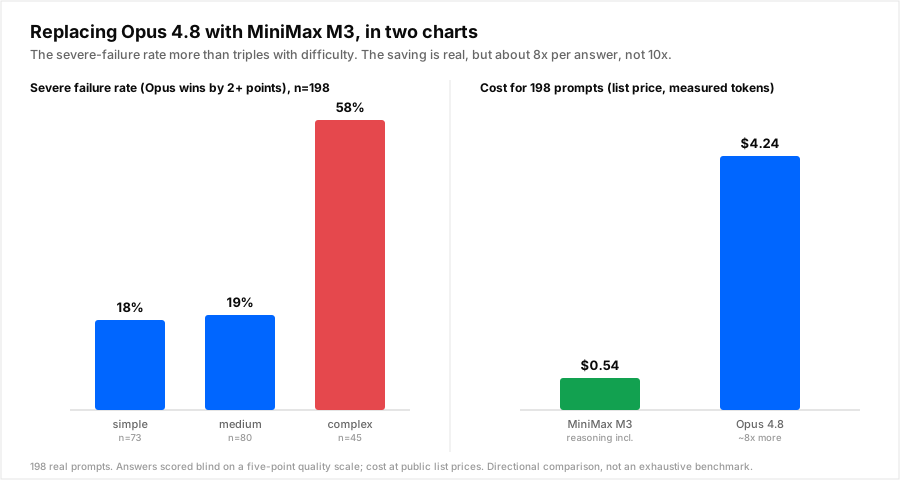
At list prices MiniMax M3 is about ten times cheaper than Opus 4.8 per token. On our 198 prompts it cost about $0.54 against roughly $4.24 for Opus, close to eight times less. The per-answer saving is nearer 8x than 10x because MiniMax is a reasoning model that writes out its thinking, so it spends more output tokens per answer than Opus does. Either way, the cost difference is large and real.
Accuracy
To measure accuracy we had both models answer the same prompt and scored each answer on a five-point quality scale. MiniMax landed within one point of Opus on 70% of prompts overall, and produced a genuinely good answer (4 out of 5 or better) on 56% of them. How well it holds up depends heavily on how hard the prompt is:
Difficulty
Answers within 1 point of Opus
Simple
77%
Medium
81%
Complex
40%
On everyday questions MiniMax keeps pace with Opus about four times out of five. On genuinely hard prompts it falls well behind.
Error rate
An average hides the risk that actually matters: how often the cheaper model returns an answer a user would notice is clearly worse. We count that as a severe drop, two or more points below Opus. Across all prompts the severe-drop rate was 27%, and it more than triples with difficulty:
Difficulty
Severe drops
Simple
18%
Medium
19%
Complex
58%
Severe-drop rate by prompt difficulty: MiniMax M3 produces a clearly worse answer than Opus 4.8 on 18% of simple prompts, 19% of medium prompts, and 58% of complex prompts, more than tripling with difficulty. Alongside, cost for 198 prompts: about $0.54 for MiniMax against $4.24 for Opus, roughly eight times cheaper per answer.
The takeaway is the shape of the risk. Even easy prompts fail severely about one time in six, and you cannot always tell which. A short factual question can trip it up while a longer, more involved one sails through, so the failures are not something you can eyeball in advance.
Latency
MiniMax M3 is also faster, not slower, despite writing out its reasoning. On the same prompts it returned a complete answer in a median of 7.0 seconds against 11.3 seconds for Opus, roughly 1.6 times quicker.
What this means for you
MiniMax M3 is a strong, fast, inexpensive model. On the majority of everyday prompts it stays within a point of Opus, costs about eight times less, and answers noticeably quicker. The catch is the tail: roughly a quarter of a wholesale swap comes back clearly worse, concentrated on harder work and rising to well over half on complex prompts. Replacing Opus everywhere is therefore a real quality risk. The safe way to capture the savings is to send easy, low-risk traffic to the cheaper model and keep hard traffic on the frontier model, rather than switching wholesale.
How Nadir captures M3's economics in production
That safe path is not a wholesale swap or a crude difficulty label, it is a per-prompt decision made after seeing the answer, and that is exactly what Nadir does. For every request it sends the prompt to the cheap, fast model first, checks the answer with a calibrated verifier, and escalates to a frontier model only when the answer is not good enough. The large share of traffic that M3 handles as well as the frontier runs on M3, capturing its cost and speed advantage, while the hard tail quietly escalates so your users never see the drop. Two lines of code, bring your own keys, and a savings dashboard that shows the real delta against always running the frontier model.
We have also been extending Nadir's verifier to natively grade MiniMax M3's reasoning-style outputs and formatting, so M3 routing is as sharp as it can be. M3 is good enough to be a first-class cheap tier, and Nadir routes it that way.
How we tested
198 real prompts sampled from an open dataset of anonymized chat conversations, spanning factual questions, coding, math, creative writing, and everyday assistant tasks. Each prompt was answered by MiniMax M3 and Claude Opus 4.8, and the two answers were scored blind on quality. Cost uses public list prices; latency is the measured time to a complete answer. This is a directional comparison across one prompt set, not an exhaustive benchmark.
Nadir is an LLM router. Nadir sizes every prompt and routes it to the
cheapest model that still clears your quality bar. A small decision model
reads each prompt against your model menu and picks the lowest-cost model
it expects to handle it. When the decision model is uncertain or
unavailable, the request goes to the strongest model on the menu. The
routing step makes no call to your model provider.
Nadir runs two ways. The decision API returns a model, reasoning-effort,
cache, context, and policy recommendation without calling a model
provider, beside the gateway you already run. That is how a shadow-mode
evaluation works, and its projected savings stay advisory. The OpenAI
compatible managed proxy executes the route, and migration is a two-line
change: point the base URL at api.getnadir.com and set model to auto. On
that path an optional verifier can score a complete non-streaming answer
and escalate to a stronger model when it misses the configured bar.
Streaming bypasses post-generation verification. BYOK is supported on
every tier.
For coding agents, Nadir Auto is a terminal launcher for Claude Code or
Codex that asks Nadir for the main-session model before each turn, with
your configured model as the fallback and cost ceiling. Delegation
integrations for Claude Code, Codex, or Cursor instead recommend a model
tier for subagent work, and the agent decides. Either way inference runs
on your own provider account, so Nadir holds no provider keys on that path.
What the numbers are, and what they are not
Nadir publishes each evaluation with its scope. On checkable code,
run-check-escalate solved 392 of 395 common HumanEval and MBPP problems
(99.2%), graded by running the canonical tests; that applies only to tasks
with runnable deterministic tests. Nadir-Tumbler posts an arena_score of
72.3 on RouterArena's public scorer, 5th of 23 routers, which measures the
routing decision on RouterArena's own model pool. A reference-assisted
RouterBench evaluation over 11,420 held-out triples produced a 60% lower
projected cost than always-Opus with about 98% retained quality and a 1.7%
catastrophic-route rate. That experiment gave the verifier the
expensive-model reference answer, which production does not have, so it
is a research ceiling and not the deployed path.
None of these is a production guarantee, a universal savings rate, or a
forecast for any particular workload. Customer savings are reported from
measured execution against a declared baseline, and customer quality only
from outcome-labelled traffic. Projected savings and realized savings are
separate artifacts and are never blended.
Design-partner program
Three rungs, picked by risk appetite. Rung 0 Shadow runs advisory decision
calls alongside live traffic and returns a projected receipt, with nothing
in the request path changed. Rung 1 Hosted is the two-line swap on a
production slice and returns a realized receipt. Rung 2 On-prem is a
supervised six-week proof of concept inside the partner's VPC, where no
prompt, response, or usage reaches Nadir. The commitments are the same at
every rung. Apply for a rung directly:
Rung 0 Shadow,
Rung 1 Hosted, or
Rung 2 On-prem.
Not sure which fits? Start at
getnadir.com/contact/?reason=design-partner.
Licensing
NadirClaw is the self-hosted core, source-available under the PolyForm
Noncommercial License. Source-available is the correct label; NadirClaw is
not open source. Nadir Route's hosted plan has no base fee and charges a
variable fee only on measured savings from requests Nadir executed.