Two admin panels, four days apart
On July 2, Anthropic shipped richer admin analytics, model-level entitlements, and spend alerts for Claude Enterprise. Admins can now set which model chat, Cowork, and Claude Code default to, break down cost by SCIM group and user, and get notified at 75% and 90% of an org spend limit before anyone gets blocked mid-task. Source: Anthropic, "New analytics and cost controls are available for Claude Enterprise," July 2, 2026.
Four days later, OpenAI moved Workspace agents and Excel and Sheets tasks to token-based credit pricing for Enterprise and Edu workspaces. A typical Workspace agent run on GPT-5.5 now costs 5 to 25 credits, priced off input tokens, cached input tokens, and output tokens, with no fixed price per run. Source: OpenAI, ChatGPT Enterprise & Edu release notes, July 6, 2026, reported by Tech Times, "OpenAI Workspace Agent Billing Went Live Monday," July 8, 2026.
Both features answer the question finance has been asking since one enterprise burned $500 million on Claude in a single month with no usage caps set: where is the money going, and how do we stop it before it goes further. Neither one changes what the next request costs.
What actually shipped
| Claude Enterprise, July 2 | ChatGPT Enterprise/Edu, July 6 | |
|---|---|---|
| The mechanism | Spend-threshold alerts (75%/90% org, 75%/95% user), model-level defaults, per-group analytics | Token-based credit pricing replacing flat seat allotments for agent runs |
| What it tells you | How close you are to a ceiling, and who is spending | How much a specific run actually cost in tokens |
| What it does not do | Pick a cheaper model when the default is too expensive for a given task | Route a run to a cheaper model when the task doesn't need GPT-5.5 |
| Where it reports | Anthropic's dashboard and Analytics API (Datadog Cloud Cost Management, CloudZero) | OpenAI's own workspace admin console |
Anthropic's own product manager described the release as a monitoring tool, not a cost-reduction one: "Cost visibility isn't a once-a-month exercise. Granular spend data and alerts give teams regular nudges to reassess how they're using Claude." Source: Kyra Abbu, quoted in Anthropic's July 2, 2026 announcement. That's an accurate description of what shipped. A nudge to reassess is not the same feature as a system that reassesses for you on every call.
The gap both releases share
FinOps vendor Finout reviewed the Anthropic release and landed on the same conclusion from a different angle: the controls are real progress, and they stop at the vendor's own edge. Cost per commit "exists only as a total," so admins "can't tell which model is earning its keep," and skill-level pricing shows "list price and overage, not the effective rate you actually pay." The larger problem is structural: "a provider's control surface governs spend with that provider" alone, and most enterprises run three to five AI providers at once, which produces "well-governed silos whose numbers still need reconciling." Source: Asaf Liveanu, Finout, "Anthropic Keeps Signaling Where AI Cost Governance Needs to Go. It's Not All the Way There Yet," July 2026.
OpenAI's shift has the identical shape from the other direction. Credit-based pricing makes the true cost of a Workspace agent run visible for the first time, which is genuinely useful. But 5 to 25 credits per run is still 5 to 25 credits spent on GPT-5.5, whatever the task actually needed. Visibility into a number is not the same lever as control over that number, the same lesson teams comparing fine-tuning against routing already learned: the hidden cost is the one that sinks the decision, not the sticker price.
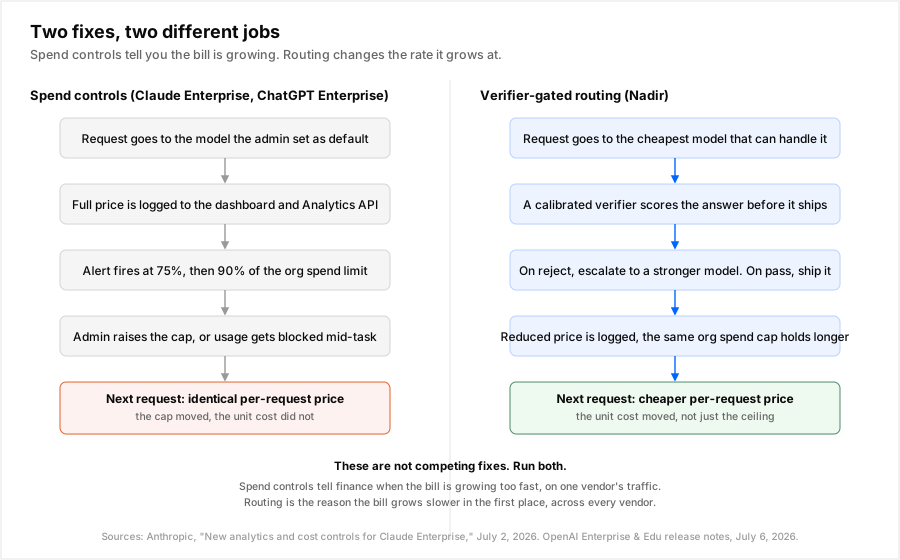
What a cap can't do that routing already does
- A cap fires after the model already ran. By the time an alert reaches 75% of a limit, every request that got you there was already billed at full price. Routing decides the price before the call goes out, not after.
- A cap sees one vendor. The average enterprise runs seven models across multiple providers with no routing layer connecting them. Anthropic's dashboard has no visibility into what the same team spent on OpenAI that week, and OpenAI's credit meter has no visibility into Claude. A router sitting in front of every provider sees the whole bill, not the slice one vendor is willing to show you.
- A model default is one setting, not a decision per request. Setting Claude Code to default to Sonnet instead of Opus helps every task that needed Sonnet anyway, and still overpays on every task that only needed Haiku. Tokenmaxxing, defaulting to the frontier model because there's no cost to the engineer who picked it, isn't fixed by moving the default up or down one notch. It just waits for the next complaint at the new number.
- Blocking a user at 100% of budget is a worse outcome than routing them cheaper at 60% of budget. Spending caps reduce the number of queries. They do not reduce the cost of each one, which means the same task volume either gets blocked or gets approved for a bigger cap next quarter. Neither path lowers the unit cost.
The one-line version of the fix
Anthropic's and OpenAI's controls are configuration, set once, by an admin, per vendor:
{
  "claude_code_default_model": "sonnet-4-5",
  "org_spend_limit_usd": 50000,
  "alert_thresholds": [0.75, 0.90]
}
That setting is correct for the median task and wrong for every task on either side of the median. It also has to be re-entered, by hand, in every other vendor's admin console your team uses.
Routing is a decision made per request, not per admin panel:
import openai

client = openai.OpenAI(
    base_url="https://api.getnadir.com/v1",
    api_key="ndr_...",
)

response = client.chat.completions.create(
    model="auto",  # cheapest model that can handle this specific request
    messages=[{"role": "user", "content": prompt}],
)
Nadir can use the same OpenAI-compatible shape for hosted execution or return a decision beside the gateway you already run. Start in shadow mode, declare the comparison baseline, and attach outcomes before enforcement. The older 60% / 98% RouterBench result supplied the expensive reference answer to the verifier, so it is a reference-assisted research ceiling—not deployed performance or a customer forecast.
What to ship this week
- Turn on the new vendor spend controls. They're free, they're correct to have, and a 75%/90% alert genuinely beats finding out at the invoice. Do this regardless of anything else in this post.
- Do not treat a model default as a routing strategy. One default per admin panel can't see the individual request the way a router can.
- Ask where your other three or four providers' dashboards are. If the answer is "we don't have one," that's the gap Finout is describing, and it's the one a cross-provider router closes by default.
- Measure cost per unit of work, not just cost per dollar spent. Anthropic's own release adds cost-per-commit for exactly this reason. Extend the same instinct to cost per resolved ticket, per completed run, per verified answer, wherever your workload produces something measurable.
Conclusion
Spend controls and credit-based pricing aren't the wrong feature. They're a different feature than the one that actually lowers a bill, and both vendors were candid enough to describe them that way even while shipping them. An alert tells an admin the bill is growing. A credit meter tells a CFO what a run cost after it ran. Routing is the layer that decides, before either of those numbers exists, whether the request needed the expensive model at all. Enterprises are one week into a world where every major vendor ships spend visibility. The bill drops when something upstream of that dashboard starts choosing a cheaper model by default, not when the dashboard gets easier to read.
Related reading
- A company burned $500M on Claude in 30 days. Spending caps are not the fix.
- Meta capped employee AI spend after costs approached billions. Uber set a $1,500-per-engineer monthly limit. "Tokenminimizing" will not fix the unit economics.
- 98% of FinOps teams now manage AI spend. Most still cannot see where the tokens go.
- Every coding agent just switched to metered billing. Routing is the only lever that scales.
- The average enterprise runs 7 AI models. Most have no routing layer.
Sources: [Anthropic, "New analytics and cost controls are available for Claude Enterprise," July 2, 2026](https://claude.com/blog/giving-admins-more-visibility-and-control-over-claude-usage-and-spend). [Asaf Liveanu, Finout, "Anthropic Keeps Signaling Where AI Cost Governance Needs to Go. It's Not All the Way There Yet," July 2026](https://www.finout.io/blog/anthropic-keeps-signaling-where-ai-cost-governance-needs-to-go.-its-not-all-the-way-there-yet). [OpenAI, ChatGPT Enterprise & Edu release notes, July 6, 2026, reported by Tech Times, "OpenAI Workspace Agent Billing Went Live Monday," July 8, 2026](https://www.techtimes.com/articles/319932/20260708/openai-workspace-agent-billing-went-live-monday-token-math-every-team-needs-now.htm).