An open source router just proved routing works. It didn't make routing free.
In September 2025, Red Hat's CTO office published a new open source project: an Envoy filter that reads the semantic content of an LLM request and routes it to the right model before the request ever reaches an inference server. Source: Red Hat Developer, "vLLM Semantic Router: Improving efficiency in AI reasoning," September 11, 2025. Dr. Huamin Chen, the Senior Principal Software Engineer who built it, put the motivation plainly: "I knew this kind of reasoning-aware routing was largely confined to closed, proprietary systems. Red Hat's open source DNA demanded we bring this crucial capability to the open source community, making it accessible and transparent for everyone." Source: Red Hat, "Bringing intelligent, efficient routing to open source AI with vLLM Semantic Router".
It gained more traction than most infrastructure launches: over 2,000 GitHub stars and nearly 300 forks within two months of debut, per Red Hat's own count. Source: Red Hat, "Bringing intelligent, efficient routing to open source AI with vLLM Semantic Router". It then shipped three tagged releases in five months: v0.1 "Iris" on January 5, 2026, v0.2 "Athena" on March 10, 2026, and v0.3 in June 2026. Source: vLLM Blog, "vLLM Semantic Router v0.1 Iris: The First Major Release," January 5, 2026; Source: GitHub, vllm-project/semantic-router releases. AMD contributes GPU capacity and ROCm support for training the project's classifiers and running its public playground. Source: GitHub, vllm-project/semantic-router.
None of that is marketing. It's a real, actively maintained, independently governed project with a published research agenda: a vision paper on workload-router-pool architecture Source: "The Workload-Router-Pool Architecture for LLM Inference Optimization," arXiv:2603.21354, March 2026 and a paper on reasoning-mode routing specifically Source: "When to Reason: Semantic Router for vLLM," arXiv:2510.08731, both listed on the project's publications page. If you're weighing whether open source semantic routing is a real category now or still a research toy, the honest answer is: it's real. The part that gets skipped in the launch posts is what it costs to run.
What it actually does.
The router sits in front of your model pool as an Envoy External Processor: a gRPC filter, written in Go for the networking path and Rust (via the Candle framework) for the ML path, that intercepts every request before Envoy forwards it. Source: Red Hat, "Bringing intelligent, efficient routing to open source AI with vLLM Semantic Router". The filter turns the incoming prompt into an embedding, compares it against task vectors, and tells Envoy which backend model cluster should handle it. Source: Red Hat Emerging Technologies, "Intelligent inference request routing for large language models," November 11, 2025.
By the Athena release, that classification step had grown into eight neural classifiers built on mmBERT-32K, a 307-million-parameter model covering more than 1,800 languages: intent, jailbreak detection, PII detection, fact-checking, hallucination detection, domain classification, complexity scoring, and safety assessment, plus keyword-pattern and embedding-similarity signals layered on top. Source: Red Hat Developer, "Getting started with the vLLM Semantic Router project's Athena release," March 25, 2026. Athena also added a signal-decision architecture for Boolean routing logic, an HNSW-based semantic cache, and 11 model-selection algorithms ranging from static rules to Thompson sampling and RouterDC. Source: Red Hat Developer, "Getting started with the vLLM Semantic Router project's Athena release," March 25, 2026. The project's own homepage describes the goal as coordinating "local, private, and frontier models" from one routing layer, sending routine traffic to efficient lanes and reserving frontier reasoning for what actually needs it. Source: vLLM Semantic Router homepage.
The benchmark that's real.
The number that gets quoted most is from the original September 2025 write-up: on MMLU-Pro with Qwen3-30B, letting the router choose between reasoning mode and standard mode per query, instead of running the model in always-on reasoning mode, cut token usage 48.5%, cut latency 47.1%, and increased accuracy 10.2%, with some domains like business and economics gaining more than 20 points. Source: Red Hat Developer, "vLLM Semantic Router: Improving efficiency in AI reasoning," September 11, 2025.
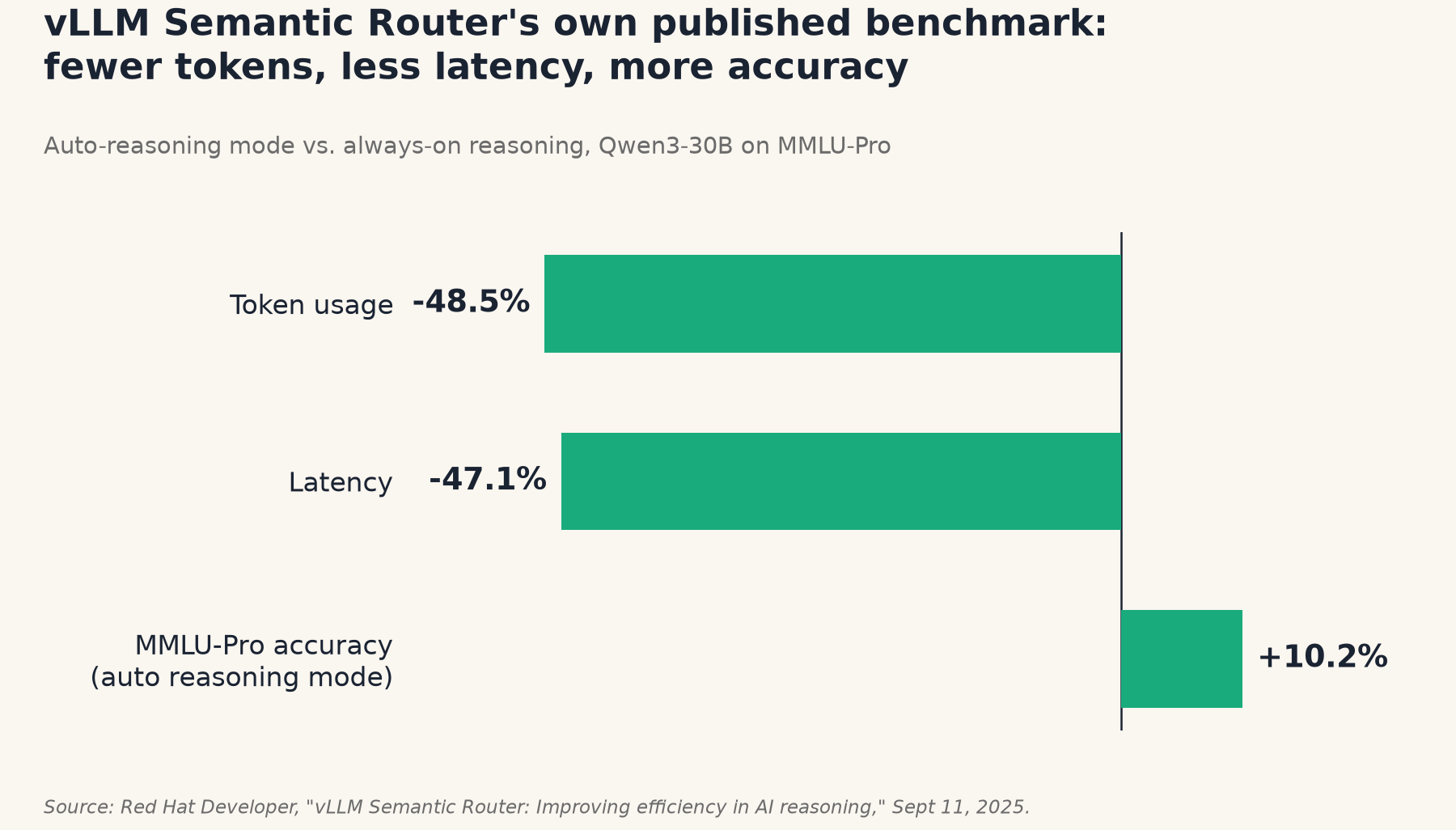
That result is worth taking seriously and worth reading narrowly. It measures one routing decision: reasoning mode on or off, on one model family, on one benchmark. It is not a claim that every workload sees a 48% token reduction, and the project doesn't claim that either. What it demonstrates is the mechanism this whole blog argues for repeatedly: a meaningful share of requests get the wrong amount of compute by default, and a classifier cheap enough to run per-request can fix that before the model ever sees the prompt. The same logic applies one layer up, at the model tier rather than the reasoning-mode toggle.
What it costs to stand up.
This is the part the release notes don't lead with. To run vLLM Semantic Router in production, the documented dependency list is: vLLM itself, PyTorch, Hugging Face model infrastructure, Kubernetes, Envoy, and Prometheus/Grafana for monitoring. Source: vLLM Semantic Router homepage. Production deployment ships through Helm charts and two custom Kubernetes resources, IntelligentPool and IntelligentRoute, with horizontal pod autoscaling wired in. Source: Red Hat Developer, "Getting started with the vLLM Semantic Router project's Athena release," March 25, 2026. The initial deployment footprint is documented at roughly 25GB for the internal ML models plus 2GB for the container image, before it has routed a single production request. Source: Red Hat Developer, "Getting started with the vLLM Semantic Router project's Athena release," March 25, 2026.
None of that is a criticism of the project. It's an accurate description of what "open source and free" means for a system-level routing layer: the software has no license fee, and someone on your team still owns a Kubernetes-native gateway, an eight-classifier ML pipeline, a semantic cache, and an observability stack, across major version jumps that landed roughly every two months this year. Quick local testing is available through Docker or Podman without the full cluster. Source: Red Hat Developer, "Getting started with the vLLM Semantic Router project's Athena release," March 25, 2026. Running it at the reliability a production API gateway needs is a different commitment than docker run.
# What "trying it" looks like today
curl -fsSL https://vllm-semantic-router.com/install.sh | bash

# What "running it in production" adds on top:
# - an Envoy deployment with the ExtProc filter wired in
# - a Kubernetes cluster (Helm chart, IntelligentPool/IntelligentRoute CRDs, HPA)
# - ~25GB of classifier models served and kept warm
# - Prometheus + Grafana for the observability the router itself doesn't give you
Source: vLLM Semantic Router homepage, installation instructions.
Self-hosted OSS router versus a drop-in proxy.
| vLLM Semantic Router (self-hosted) | Nadir (hosted proxy) | |
|---|---|---|
| License cost | Free, open source | Free with BYOK; usage-based on the hosted plan |
| Infra you own | Envoy, Kubernetes, classifier hosting, Prometheus/Grafana | None; point your base URL at the proxy |
| Classifier | You train, host, and upgrade across major versions | Maintained centrally, versioned for you |
| Time to first routed request | Cluster setup, Helm install, CRDs, then traffic | A base URL change |
| Where it fits | Teams already running vLLM/Kubernetes at scale, or with a hard requirement to keep classification fully in-house | Teams whose LLM calls already hit hosted APIs (Claude, GPT, Gemini) and want routing without hiring for it |
| Verification before shipping a route | Not the project's stated focus | Verifier-gated: a calibrated model checks the cheap answer before it ships |
Both rows are legitimate answers to "how do I stop sending every request to the most expensive model." They're just answers for different teams. If you're already operating a vLLM fleet behind Kubernetes and Envoy, the marginal cost of adding this router is low, and full control over the classifier is a feature, not overhead, especially if PII or jailbreak detection has to stay inside your own network boundary for compliance reasons. If your traffic already goes to hosted frontier APIs and nobody on the team wants to own a new Kubernetes-native gateway, Nadir is the same routing idea with the operational side absorbed: swap the base URL, set model=auto, and the classification, fallback chains, and cost dashboard are already running.
A checklist before you adopt either one.
- Don't evaluate "open source" as "zero cost." The license is free. The Kubernetes cluster, the classifier hosting, the Prometheus stack, and the engineer-hours to track three major releases in five months are real, ongoing costs.
- Read the benchmark's scope before you extrapolate it. 48.5% fewer tokens and 47.1% lower latency describe one routing decision (reasoning mode on/off) on one model on one benchmark. It's a real number for that decision, not a universal savings rate.
- Match the tool to the traffic you already have. A team running its own vLLM inference fleet is a different starting point than a team calling Anthropic and OpenAI's hosted APIs. The right router looks different from each starting point.
- Weigh in-house classification against compliance requirements. If PII or jailbreak detection has to run inside your own network, self-hosting isn't optional. If it doesn't, it's one more system to operate.
- Watch the release cadence. Three major versions in five months is a healthy, fast-moving project. It also means whoever owns this in your stack is signing up to track breaking changes on that schedule.
Conclusion.
vLLM Semantic Router is a genuinely good outcome for the industry: reasoning-aware routing, jailbreak and PII detection, and multi-model orchestration are no longer locked inside proprietary gateways, and a well-resourced open source project is iterating on all three in public. The 48.5% token reduction and 47.1% latency reduction it reports are real, published numbers, not vendor marketing math. What's also real is that "open source" describes the license, not the operational cost. Standing this up means a Kubernetes cluster, an Envoy deployment, roughly 25GB of classifier models kept warm, and a monitoring stack, before it routes a single production request, and someone has to keep all of it current across a release cadence measured in weeks. For teams already living in that infrastructure, that's a fair trade for full control. For teams whose LLM traffic already goes to hosted APIs, the same routing idea is available without becoming a platform team's new full-time project.
Data in the chart is drawn directly from the cited Red Hat Developer benchmark, not derived from proprietary production traces. Sources: [Red Hat Developer, "vLLM Semantic Router: Improving efficiency in AI reasoning," September 11, 2025](https://developers.redhat.com/articles/2025/09/11/vllm-semantic-router-improving-efficiency-ai-reasoning). [Red Hat, "Bringing intelligent, efficient routing to open source AI with vLLM Semantic Router"](https://www.redhat.com/en/blog/bringing-intelligent-efficient-routing-open-source-ai-vllm-semantic-router). [Red Hat Emerging Technologies, "Intelligent inference request routing for large language models," November 11, 2025](https://next.redhat.com/2025/11/11/intelligent-inference-request-routing-for-large-language-models/). [Red Hat Developer, "Getting started with the vLLM Semantic Router project's Athena release," March 25, 2026](https://developers.redhat.com/articles/2026/03/25/getting-started-vllm-semantic-router-athena-release). [vLLM Blog, "vLLM Semantic Router v0.1 Iris: The First Major Release," January 5, 2026](https://blog.vllm.ai/2026/01/05/vllm-sr-iris.html). [GitHub, vllm-project/semantic-router](https://github.com/vllm-project/semantic-router). [vLLM Semantic Router homepage](https://vllm-semantic-router.com/). ["The Workload-Router-Pool Architecture for LLM Inference Optimization," arXiv:2603.21354](https://arxiv.org/pdf/2603.21354). ["When to Reason: Semantic Router for vLLM," arXiv:2510.08731](https://arxiv.org/pdf/2510.08731).