The demo never mentions the bill.
Every voice AI launch video sounds the same: a warm synthetic voice picks up on the first ring, understands an interruption mid-sentence, and books the appointment before the caller finishes their sentence. What it doesn't show is the invoice. The global AI voice agent market is projected to pass $4.8 billion in 2026, growing at roughly 38% a year, and more than 65% of enterprise contact centers have deployed or are piloting conversational voice AI. Source: EchoCall, "AI Voice Agent & Conversational AI Statistics 2026"; Source: NextLevel.ai, "Voice AI Trends 2026: Enterprise Adoption & ROI Guide". Almost none of that adoption curve is priced the way a chat product is priced, and the gap is bigger than most teams porting a chatbot into a phone line expect.
Two multipliers, not one.
Applied Brain Research ran the comparison directly: calling a text-only LLM API costs roughly $1.50 per million tokens. Wrap that same model in cloud speech-to-text and cloud text-to-speech to make it talk, and the realized cost rises to roughly $14.50 per million token-equivalents at May 2026 pricing — close to a 10x jump before a single word of the conversation changes. Source: Applied Brain Research, "Cloud Voice AI Costs: The Hidden Economics of Speech at Scale". The jump isn't one bad line item. It's two multipliers stacking: audio tokens are priced higher per token than text, and audio streams tokenize into more tokens per second of content than the equivalent text would. Neither multiplier alone explains the gap. Together they do.
What the providers actually charge, in their own pricing pages.
The clearest way to see the spread is to read the primary sources instead of a vendor's marketing page. OpenAI's Realtime API prices audio input at $32 per million tokens ($0.40 per million cached) and audio output at $64 per million tokens, next to $4 per million for text input and $24 per million for text output on the same model. Source: OpenAI, Realtime API pricing. Google's Gemini Live API prices audio input at $3 per million tokens and audio output at $12 per million tokens, tokenizing audio at a fixed 25 tokens per second regardless of what's being said. Source: Google AI for Developers, Gemini API pricing.
Sit those two next to each other and the spread on audio output alone — $12 to $64 per million tokens — is 5.3x between two frontier providers' realtime endpoints. That's the same shape of price spread this blog tracks every week on text models. The cheapest output token on a text model already runs 75x cheaper than the most expensive one. Voice just adds a second axis: the same spread, now compounding with a sub-second latency budget that makes "just route it to the cheap model and check the answer" a much harder trick to pull off live, on a phone call, mid-sentence.
| Provider / architecture | Audio input | Audio output | Notes |
|---|---|---|---|
| OpenAI Realtime API | $32 / M tokens ($0.40 cached) | $64 / M tokens | Text on the same model: $4 in / $24 out per M |
| Google Gemini Live API | $3 / M tokens | $12 / M tokens | 25 tokens/sec fixed tokenization rate |
| Cascaded stack, blended (GPT-4o + Deepgram + ElevenLabs via Retell) | — | — | ~$0.11–$0.15/min in production |
| Cascaded stack, blended (Vapi orchestration + STT/LLM/TTS) | — | — | $0.05/min orchestration fee; ~$0.25–$0.33/min all-in |
| OpenAI Realtime, real-world sessions | — | — | $0.18–$0.46/min uncached; $0.05–$0.10/min with caching + trimmed tools |
Sources: OpenAI Realtime pricing; Gemini API pricing; Ringlyn, "AI Voice Agent Pricing Per Minute in 2026"; Softcery, "AI Voice Agent Cost Calculator 2026"; Retell AI, "AI Voice Agent Pricing in 2026"; CallSphere, "OpenAI Realtime API Cost Per Minute"; TokenMix, "OpenAI Realtime Voice 2026".
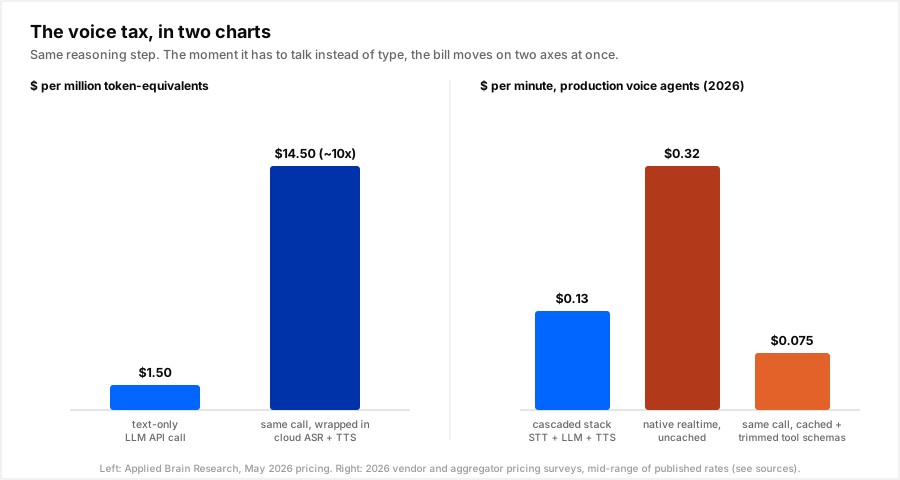
Cascaded vs. native: the architecture decision is the cost decision.
There are two ways production voice agents are actually built right now, and they carry completely different cost profiles. A cascaded stack chains three separate services: speech-to-text (Deepgram, Whisper), a text LLM as the reasoning "brain" (GPT-4o, Claude, Gemini), and text-to-speech (ElevenLabs, Cartesia, PlayHT), usually behind an orchestration layer like Vapi or Retell. A native speech-to-speech model, like OpenAI's Realtime API or Gemini Live, does all three in one audio-native pass with no text intermediate step.
Native models win on latency — there's no serialization tax between three separate network hops — which is why sub-second response time keeps showing up as the industry's line in the sand: most platforms run 500-900ms end-to-end today, and above roughly 700ms callers start rating the conversation "uncomfortable" or "robotic." Source: EchoCall, "AI Voice Agent & Conversational AI Statistics 2026". But that single audio-native bill is also a black box: you can't cache the system prompt separately from the audio codec, you can't swap in a cheaper model for a simple turn without swapping the whole pipeline, and you're priced entirely on the provider's audio-token rate card.
Cascaded stacks give up some of that latency margin, but every component in the chain is independently priced, independently swappable, and — for the LLM leg specifically — is just a normal chat completions call. That last part matters more than the pricing tables above suggest, because it's the one piece of a voice agent that every technique this blog has already covered for text still applies to, unmodified.
The turn your caller can't see is the one that's billed like every other one.
Strip away the audio codec and a cascaded voice agent's "brain" call looks exactly like a chat completions request: a system prompt carrying the agent's persona and business rules, a set of tool schemas for booking, CRM lookup, or order status, and the full conversation history so far, resent on every single turn because the API has no memory between calls. That's the same accumulation pattern that makes a 20-turn chat session bill its opening message 20 times over, the same tool-schema tax that MCP servers pay on every call, and the same system-prompt bloat that grows silently until someone audits it. Voice doesn't create a new problem here. It just runs the old one on a much shorter clock: a 900-token system prompt an engineer would happily eat on a chat app becomes 200-400ms of added time-to-first-token on a phone call, which is the difference between "natural" and "uncomfortable" by the industry's own benchmark.
That's also exactly where a caller is still being billed for nothing: most platforms stream audio continuously and bill for the full call duration, dead air included, unless voice activity detection or push-to-talk is explicitly configured to stop the meter. Source: BitBytes, "AI Voice Agent Pricing: Full Cost Breakdown (2026)". Full-duplex architectures carry a version of the same tax at the model level — some full-duplex spoken dialogue systems have to predict explicit silence tokens to hold the listening channel open, which is compute spent on saying nothing. Source: "The Silent Thought: Modeling Internal Cognition in Full-Duplex Spoken Dialogue Models via Latent Reasoning," arXiv:2603.17837; Source: "τ-Voice: Benchmarking Full-Duplex Voice Agents on Real-World Domains," arXiv:2603.13686.
For the reasoning-LLM leg of a cascaded stack, the fix is the one this blog keeps coming back to because it keeps being the fix: cache what repeats, route what doesn't need the frontier model, and don't resend what the model already answered. It's the same base URL swap whether the caller is typing or talking.
# A cascaded voice agent's "brain" step is a normal chat completions call.
# Point the orchestrator's custom-LLM URL at Nadir; the system prompt and
# tool schemas (booking, CRM lookup) get cached, and each turn routes to
# the cheapest model that can still handle it — before TTS ever sees the reply.

import openai

client = openai.OpenAI(
    base_url="https://api.getnadir.com/v1",   # was: https://api.openai.com/v1
    api_key="YOUR_NADIR_KEY",
)

response = client.chat.completions.create(
    model="auto",  # Nadir routes per turn; your voice stack doesn't have to guess
    messages=[
        {"role": "system", "content": AGENT_PERSONA_AND_TOOL_RULES},
        *conversation_history,  # resent every turn — this is what gets cached
        {"role": "user", "content": transcribed_utterance},
    ],
    tools=BOOKING_AND_CRM_TOOLS,
    max_tokens=120,  # a phone reply is a sentence, not an essay — cap it
)
That's the honest scope of it: this applies to the cascaded architecture, where the reasoning step is a text completions call sitting between STT and TTS — which describes most production voice stacks surveyed above, since Retell, Vapi, and similar platforms are explicitly built by wiring a chosen STT, LLM, and TTS provider together. Source: Ringlyn, "AI Voice Agent Pricing Per Minute in 2026". It does not apply to a single audio-native realtime call, where the audio, reasoning, and speech generation are one billed unit with no text completions step to intercept. If your stack is cascaded, the routing and caching layer you'd add for a chat product is the same layer that cuts the "brain" leg of a phone call — no new integration, because there isn't a new API.
A checklist before you ship a voice agent.
- Read the primary pricing page, not the landing page. OpenAI and Google publish exact per-token audio rates; vendor per-minute quotes usually bundle a markup on top of those rates plus their own STT/TTS choices.
- Decide cascaded vs. native on latency and control, not just on price. Native models win the latency race; cascaded stacks win on the ability to cache, route, and swap components independently.
- Cap output tokens on every turn. A phone reply that runs long doesn't just cost more — every extra second is dead air the caller hears.
- Cache the parts of the call that repeat. System prompt, agent persona, and tool schemas are identical on turn one and turn twenty; only the transcript changes.
- Turn on voice activity detection or push-to-talk. If the platform bills continuous streaming, silence is billed at the same rate as speech unless something stops the meter.
- Measure cost per completed call, not per minute. A cheaper per-minute rate on a call that takes three extra turns to resolve isn't actually cheaper.
The bill is the same argument, on a shorter clock.
None of this is a reason to avoid voice AI — the ROI case is real: providers report AI voice handling dropping cost per interaction from roughly $8 with a human agent to around $0.40 automated, with payback periods reported around 2.8 months. Source: Retell AI, "AI Voice Agent Pricing in 2026: Full Cost Breakdown, Platform Comparison & ROI Analysis". It's a reason to price the architecture before you ship it, not after the first month's invoice. The multipliers are real and well documented on the providers' own pricing pages, the cascaded architecture that most production stacks actually run puts a normal, cacheable, routable chat completions call at the center of every turn, and the latency budget that makes voice feel natural is the same budget that makes an oversized, uncached prompt cost you twice: once in dollars, once in the silence the caller hears while it's billed.
Sources: [EchoCall, "AI Voice Agent & Conversational AI Statistics 2026"](https://echocall.de/en/blog/ai-voice-agent-statistik-2026). [NextLevel.ai, "Voice AI Trends 2026: Enterprise Adoption & ROI Guide"](https://nextlevel.ai/voice-ai-trends-enterprise-adoption-roi/). [Applied Brain Research, "Cloud Voice AI Costs: The Hidden Economics of Speech at Scale"](https://www.appliedbrainresearch.com/cloud-voice-ai-costs). [OpenAI, Realtime API pricing](https://developers.openai.com/api/docs/pricing). [Google AI for Developers, Gemini API pricing](https://ai.google.dev/gemini-api/docs/pricing). [Ringlyn, "AI Voice Agent Pricing Per Minute in 2026"](https://www.ringlyn.com/blog/ai-voice-agent-pricing-per-minute-2026/). [Softcery, "AI Voice Agent Cost Calculator 2026"](https://softcery.com/ai-voice-agents-calculator). [Retell AI, "AI Voice Agent Pricing in 2026"](https://www.retellai.com/blog/ai-voice-agent-pricing-full-cost-breakdown-platform-comparison-roi-analysis). [CallSphere, "OpenAI Realtime API Cost Per Minute"](https://callsphere.ai/blog/vw2c-openai-realtime-cost-per-minute-math-2026). [TokenMix, "OpenAI Realtime Voice 2026"](https://tokenmix.ai/blog/openai-realtime-voice-api-2026-cost-latency). [BitBytes, "AI Voice Agent Pricing: Full Cost Breakdown (2026)"](https://www.bitbytes.io/blog/ai-voice-speech-tools/ai-voice-agent-pricing). ["The Silent Thought: Modeling Internal Cognition in Full-Duplex Spoken Dialogue Models via Latent Reasoning," arXiv:2603.17837](https://arxiv.org/pdf/2603.17837). ["τ-Voice: Benchmarking Full-Duplex Voice Agents on Real-World Domains," arXiv:2603.13686](https://arxiv.org/pdf/2603.13686).