On July 31, 2026, Cursor's usage page quietly stopped showing what you'd spent in dollars and started showing raw token counts instead. Self-serve users on Pro and Business plans now see a number like "142,000 tokens" where a dollar figure used to sit; enterprise accounts still see dollars, and the underlying billing hasn't changed at all, only what the page tells you about it. The change never appeared in Cursor's changelog. It surfaced when someone noticed the CSV export was broken, posted about it on Cursor's community forum, and watched the thread run past five pages before a Cursor engineer replied. The post that followed on Hacker News, "Cursor removed cost information from the usage page and CSV export," pulled well over 300 points and more than 150 comments in days. The core complaint wasn't the missing decimal point. It was that a token count, on its own, tells you almost nothing: the same 1,000,000 tokens costs $0.14 on one model and $10.00 on another, a 71x spread on input pricing alone, and the page no longer does that arithmetic for you. Here's exactly what changed, why it landed as badly as it did, what two other platforms did in the opposite direction the same week, and the one number an AI tool's bill should always show you, whether or not the vendor wants to compute it.
What actually changed
Until July 31, Cursor's Dashboard > Usage page broke consumption down in dollars, per request and per model. After that date, self-serve plans see token counts instead. A separate page, Dashboard > Spending, still shows dollar totals, and enterprise plans kept their dollar view throughout. Cursor's own CSV export briefly stopped including cost data entirely, which is what surfaced the change: a user exporting their usage history for an internal report noticed the dollar column was gone.
A Cursor team member, posting under the handle jonjohnsen, explained the CSV break as accidental: "We did accidentally break dollar costs in the Usage CSV export yesterday while cleaning up an old feature flag... That was not intentional and the CSV export is fixed now." The broader shift from dollars to tokens on the Usage page itself, though, was deliberate — Cursor's stated reasoning was that showing included-plan usage in dollars was misleading, since dollars only start mattering once a user crosses into on-demand billing beyond what their plan includes.
That's a defensible point about one specific number. It doesn't explain why the fix was to remove the dollar figure rather than label it more clearly, and it doesn't touch the part users were actually upset about: a circular usage indicator that had let people glance at the page and see, at a glance, how close they were to their limit was gone along with it.
Why a token count alone tells you nothing
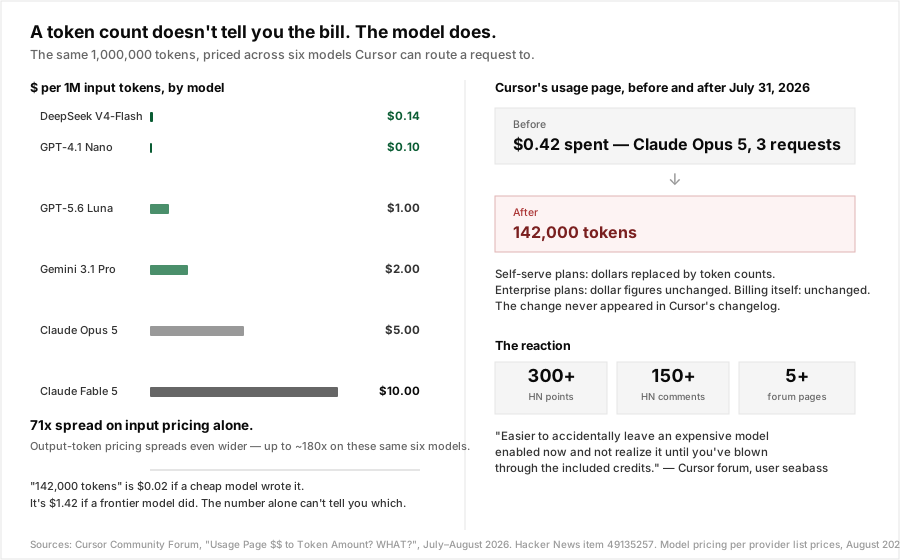
Cursor routes requests across multiple underlying models depending on which one you've selected or which the Auto mode picks. Those models are not priced anywhere close to each other. Using the same provider list prices this blog cited two weeks ago: DeepSeek V4-Flash runs $0.14 per million input tokens, GPT-5.6 Luna runs $1.00, Gemini 3.1 Pro runs $2.00, Claude Opus 5 runs $5.00, and Claude Fable 5 runs $10.00. That's a 71x spread on input pricing among models a single Cursor user might reasonably select in the same week, and the gap on output-token pricing, where the real spend usually concentrates, runs even wider.
So "142,000 tokens" isn't a bill. It's an input to a calculation the page used to run for you and now expects you to run yourself: multiply by the rate of whichever model actually generated those tokens, remember that rate changed the last time the provider repriced, and hope you got the on-demand multiplier right. A number of Cursor forum users made close to the same point. User seabass described the practical effect of removing the circular indicator: it's now "easier to accidentally leave an expensive model enabled now and not realize it until you have blown through the included credits." User EugeneOZ, responding to the suggestion that admins could still check dollar totals elsewhere, put the friction plainly: "it doesn't matter, I'm not going to ping admin every day to check how it goes." User cebert was blunter about the underlying assumption: "Do you really think that users on a subscription plan aren't intelligent enough to know [what they're spending]... This is a terrible change."
None of those comments accuse Cursor of hiding the ball on purpose. The frustration is narrower and, honestly, more damning for anyone trying to run a team on a fixed monthly plan: a token count without a per-model rate is not a proxy for a dollar figure, it's a different unit entirely, and converting between them requires information the page stopped giving you.
The same week, two platforms went the other direction
Set this against what happened elsewhere in the same eleven days. Anthropic shipped a Claude Code update that surfaces gateway spend limits directly inside usage warnings — the spending cap itself, when it resets, and any operator-set message — so a developer working inside an org-managed gateway sees the dollar ceiling they're up against before they hit it, not after. On August 11, 2026, Google turned on overage and monthly spend-limit controls for Gemini Enterprise administrators, giving them a dollar boundary they can set and a combined view of feature usage and cost across the Gemini Enterprise and Cloud Billing consoles.
Read the three changes together and they're not really about the same feature. Cursor's change removed a dollar-denominated signal from an interface individual users read every day. Anthropic's and Google's changes added dollar-denominated signals to interfaces that administrators and developers read to decide whether to keep spending. All three shipped inside the same two-week window, which says less about any one company's intent and more about where the ground floor of AI tooling actually sits in August 2026: spend visibility isn't a nice-to-have feature anymore, it's the thing every vendor in this category is now being measured against, in either direction.
This is the exact lever the industry just gave a name to
The Linux Foundation's Tokenomics Foundation, launched August 4, 2026 with thirty founding members including IBM, Oracle, and JPMorganChase, named this pattern directly in its first published framework. Big-T notation's fourth of five recommended cost-control levers is "abstraction transparency": expose token-level telemetry per call instead of hiding usage behind a flat credit bundle a team can't decompose. A standards body backed by three of the ten largest companies on earth is telling enterprises, in writing, to demand exactly the number Cursor just made harder to see on its own product.
That's not a coincidence of timing so much as a sign the pattern is well understood at this point. A credit, a token count, or a bundled allowance is only legible to the person who already knows the conversion rate. Everyone else is being asked to trust a number they can't independently check.
What to actually check on your own AI tool bill
Four questions worth running against whatever coding assistant, agent platform, or API gateway your team is on right now, regardless of whether it's Cursor:
- Does the usage view show a dollar figure, or does it show a unit that requires a rate card to interpret? Tokens, credits, and "requests" are all abstractions over a dollar amount set by whichever model handled the call.
- If it's tokens or credits, do you know which model burned them, and that model's current rate? A provider repricing, which happened to DeepSeek's entire budget tier days after this blog covered it as the cheap option, can silently move that conversion rate without anyone updating the number you're reading.
- Is there an early-warning signal before you cross into overage, or only a total after the fact? The circular indicator Cursor removed was, functionally, that signal — a glance-and-know check rather than a monthly reconciliation.
- Does the answer change depending on your plan tier? Cursor's enterprise accounts kept dollar figures throughout. If the visibility a self-serve user gets is worse than what an enterprise contract negotiates, that's worth knowing before you're the one stuck doing the arithmetic.
Where Nadir fits
Every one of those four questions has the same underlying fix: a per-request dollar figure that doesn't depend on which model handled the call, doesn't require you to track a rate card, and doesn't change shape depending on your plan tier. Complete non-streaming responses from Nadir report actual cost in nadir_metadata.cost.total_cost_usd; when a benchmark is configured and priced, nadir_metadata.benchmark_comparison.savings_usd adds the avoided-spend comparison. It's the same visibility Big-T's abstraction-transparency lever asks for, applied automatically on the request path instead of depending on whichever product team decides the usage page needs a redesign next quarter.
Conclusion
Cursor's own explanation for the change is reasonable on its narrowest reading: a dollar figure on included-plan usage was, in fact, potentially misleading about what triggers on-demand billing. But the fix removed the one number every user actually needed to answer a much simpler question — am I about to spend more than I meant to — and replaced it with a unit that only means something once you already know the rate. The same eleven days saw Anthropic and Google add exactly that kind of dollar-denominated visibility to their own products, and a Linux Foundation-backed standards body named the pattern outright as one of the five things that actually moves an AI cost bill. Whatever tool sits between you and a model provider, the question worth asking isn't how many tokens it used. It's what that cost, in a currency you don't have to convert.
Related reading
Sources: Cursor Community Forum, ["Usage Page $$ to Token Amount? WHAT?"](https://forum.cursor.com/t/usage-page-to-token-amount-what/167153), July-August 2026. Hacker News, ["Cursor removed cost information from the usage page and CSV export"](https://news.ycombinator.com/item?id=49135257), August 2026. daily.dev, ["Cursor removed cost information from the usage page and CSV export"](https://daily.dev/posts/cursor-removed-cost-information-from-the-usage-page-and-csv-export-z3dirxq1z), August 1, 2026. FinOps Weekly, "AI Provider Cost Updates," August 13, 2026, on Claude Code gateway spend limits and Gemini Enterprise overage controls. Linux Foundation, "Linux Foundation Launches the Tokenomics Foundation to Define the Economics and ROI of AI Value," August 4, 2026. Provider pricing pages for OpenAI, Anthropic, Google, and DeepSeek, accessed August 2026.