Google shipped Gemini 4 Neon on November 18 at $3 input and $15 output per million tokens. For the next ten days that makes it 50% more per token than Gemini 4 Carbon, which still bills its introductory $2/$10. On December 1, Carbon and Argon go to $4/$20 and Neon stays at $3/$15. Overnight, Neon becomes 25% cheaper per token than Carbon, and Google says it is about 32% cheaper per task at the default thinking level. The price you compare today is the wrong one to plan on. This post covers what Neon costs, where its bill comes from, how to staff an agent with Neon and Hydrogen, and the code to set the thinking level per role.
Prices are from Google's [Gemini API pricing page](https://ai.google.dev/gemini-api/docs/pricing) as of November 20, 2026. Benchmarks and per-task figures are from Google's launch materials and Artificial Analysis, as summarized by [eesel](https://www.eesel.ai/blog/gemini-4-neon), [explainx](https://explainx.ai/blog/gemini-4-neon-launch-price-benchmarks-vs-carbon-hydrogen-november-2026), [AI Weekly](https://aiweekly.co/alerts/google-launches-gemini-4-neon-at-315-per-million-tokens) and [CellCog](https://cellcog.ai/blog/gemini-4-neon/). Most benchmarks are vendor-reported. Check the pricing page before you plan around any number here.
The Gemini 4 price sheet, before and after December 1.
| Model | Input / 1M | Cached input / 1M | Output / 1M (incl. thinking) | Batch and Flex | Free tier |
|---|---|---|---|---|---|
Gemini 4 Neon (gemini-4-neon) | $3.00 | $0.15 | $15.00 | $1.50 / $7.50 | No |
| Gemini 4 Carbon, to Nov 30 | $2.00 | $0.10 | $10.00 | $1.00 / $5.00 | No |
| Gemini 4 Carbon, from Dec 1 | $4.00 | $0.20 | $20.00 | $2.00 / $10.00 | No |
| Gemini 4 Argon, from Dec 1 | $4.00 | $0.20 | $20.00 | $2.00 / $10.00 | No |
| Gemini 4 Hydrogen | $1.50 | $0.075 | $7.50 | $0.75 / $3.75 | Yes |
| Gemini 3.8 Flash, to Dec 31 | $0.75 | $0.075 | $3.75 | Yes |
Five details from the rate card that change a budget:
- Neon has one price across its 1M-token window. No long-context tier, so a 600K-token prompt bills at the same rate as a 6K one. That is unusual among frontier models, and it matters for repo-scale agents.
- Neon supports implicit caching only. Explicit cached content is not supported, so code that creates a cache with a TTL for Argon has to change. Cached reads bill at 5% of input.
- Priority is 1.8x. $5.40 input and $27 output, for traffic where a person is waiting.
- No free tier. Hydrogen and 3.8 Flash have one. Neon and Carbon do not, so prototypes that ran free on Hydrogen will start billing the day someone swaps the model string.
- Carbon's change now has a date. When Carbon launched in October, Google gave the later price but no date. The pricing page now lists December 1 for Carbon as well as Argon.
Same prompt, two dates.
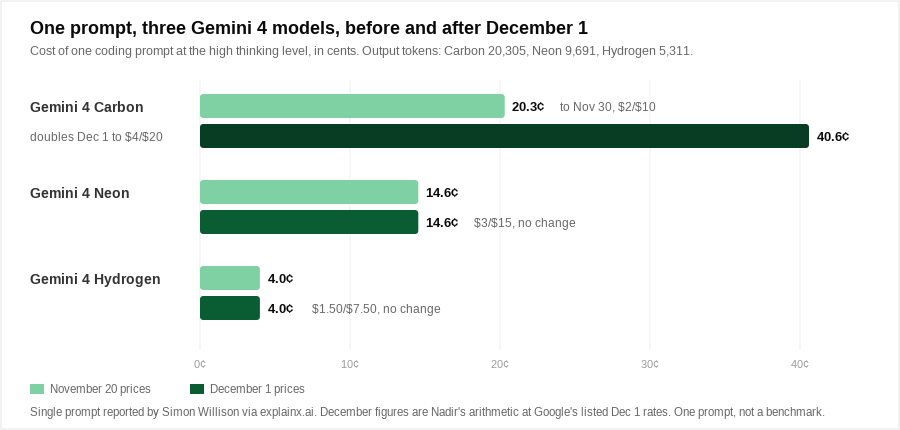
Simon Willison ran one coding prompt through all three models at the high thinking level on launch day, as reported by explainx. Carbon wrote 20,305 output tokens for 20.31 cents. Neon wrote 9,691 for 14.55 cents. Hydrogen wrote 5,311 for 3.99 cents. Carbon is already the most expensive of the three on that prompt, even at its introductory price, because it writes twice as much as Neon. On December 1, the same 20,305 tokens bill at $20 per million: about 40.6 cents.
One prompt is not a benchmark. It does show the pattern that decides a Gemini 4 bill: the token count moves more than the rate. Carbon's per-token price is 33% below Neon's today, and it still costs 40% more on this prompt.
Where Neon's bill comes from.
Output costs 5x input on Neon, and Google's pricing page labels every output price "including thinking tokens". Neon has four thinking levels: low, medium, high and xhigh, with `high` as the default. eesel reports that Argon defaulted to medium, so moving an Argon call to Neon without setting the level raises the default on its own.
Artificial Analysis's numbers for Neon, via eesel:
| Thinking level | Intelligence Index | Output tokens across the index | Output cost at $15/1M | Minutes per task |
|---|---|---|---|---|
low | 44 | 3.7 | ||
medium | 55 | 8.3 | ||
high (default) | 60 | 123M | $1,845 | 14.8 |
xhigh | 61 | 283M | $4,245 | 21.5 |
Output cost is our arithmetic from Artificial Analysis's token counts at Neon's list price. Blank cells were not reported in our sources.
From `high` to `xhigh` buys one index point for 2.3x the output tokens and 45% more wall time per task. From medium to high buys five points. Those are averages over a benchmark, not your tasks, but the shape is the same one we measured on Hydrogen in Twice the Rate, Quarter the Task: the last level is the expensive one. Keep xhigh for the requests that fail at high.
eesel also reports that Neon rejects thinking_budget and the minimal level with an HTTP 400, and ignores temperature, top_p and top_k. We found that in one source only. Test it in a branch before you ship a migration.
Neon plans, Hydrogen works.
Google's own Antigravity setup runs Neon as a "high-judgment orchestrator" directing parallel Hydrogen subagents. That is a routing decision made by role, and it is the biggest cost lever in this post.
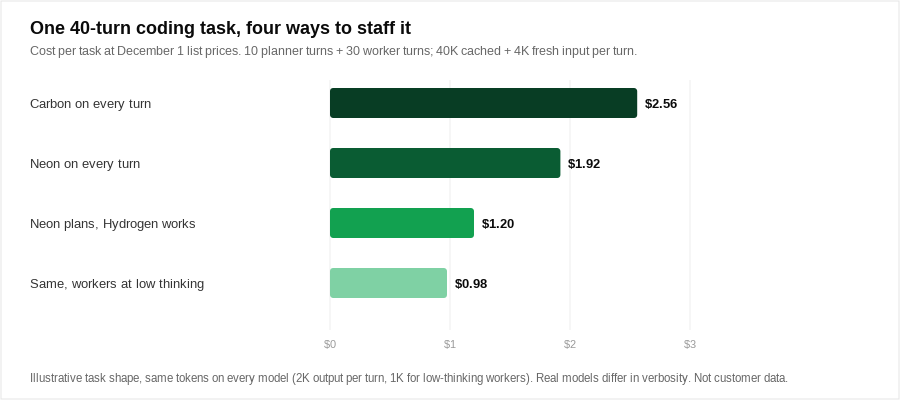
Take a coding task with 10 planning turns and 30 worker turns. Every turn reads 40K cached tokens (system prompt, tools, repo map) and 4K fresh ones, and writes 2K tokens including thinking.
| Setup | Planner turns | Worker turns | Per task | Per month at 2,000 tasks |
|---|---|---|---|---|
| Carbon on every turn, Dec 1 price | 10 x $0.064 | 30 x $0.064 | $2.56 | $5,120 |
| Neon on every turn | 10 x $0.048 | 30 x $0.048 | $1.92 | $3,840 |
| Neon plans, Hydrogen works | 10 x $0.048 | 30 x $0.024 | $1.20 | $2,400 |
Same, workers at low (1K output) | 10 x $0.048 | 30 x $0.0165 | $0.98 | $1,950 |
An illustrative task shape, not a measurement or customer data. It holds the token counts equal across models, which flatters Carbon: on the prompt above Carbon wrote twice Neon's output. Carbon at its November price would be $1.28 a task.
Moving from Carbon to Neon saves 25%, which is the per-token gap. Splitting the roles saves another 37%. Dropping the workers to low saves 19% more. The split is worth more than the model swap, and it does not depend on a price that changes in ten days.
Two conditions make the split pay. The worker turns have to be work Hydrogen passes: reading files, running tests, applying a planned edit. And each subagent should keep its own stable context, because the cache is per model. A worker that inherits the planner's history pays full input to warm a second cache, the switch penalty we worked through in Your Router Is Fighting Your Prompt Cache.
Tutorial: set the model and thinking level per role.
With the google-genai Python SDK:
from google import genai
from google.genai import types

client = genai.Client()

# One place to decide model and thinking level per role.
ROLES = {
    "planner": ("gemini-4-neon", "high"),
    "hard":    ("gemini-4-neon", "xhigh"),    # only after a failed "high" attempt
    "worker":  ("gemini-4-hydrogen", "low"),
    "lookup":  ("gemini-4-hydrogen", "low"),
}

PRICES = {  # USD per 1M tokens: input, cached input, output (incl. thinking)
    "gemini-4-neon":     (3.00, 0.15, 15.00),
    "gemini-4-hydrogen": (1.50, 0.075, 7.50),
}

def call(role: str, contents, max_output: int = 8192):
    model, level = ROLES[role]
    resp = client.models.generate_content(
        model=model,
        contents=contents,
        config=types.GenerateContentConfig(
            thinking_config=types.ThinkingConfig(thinking_level=level),
            max_output_tokens=max_output,
        ),
    )
    u = resp.usage_metadata
    cached = u.cached_content_token_count or 0
    fresh = (u.prompt_token_count or 0) - cached
    out = (u.candidates_token_count or 0) + (u.thoughts_token_count or 0)
    p_in, p_cache, p_out = PRICES[model]
    cost = (fresh * p_in + cached * p_cache + out * p_out) / 1e6
    print(f"{role:8} {model:18} {level:6} think={u.thoughts_token_count} cost=${cost:.4f}")
    return resp
Three things to watch in the log:
- `thoughts_token_count` is billed as output but reported apart from
candidates_token_count. Add them before you compare models, or Neon will look cheaper than it is. - `cached_content_token_count` should be most of the prompt on planner turns after the first. If it stays at zero, something near the top of the prompt changes on every call. A timestamp is the usual cause.
- Escalate on failure, not by default. Run a hard request at
high, check the result, and retry atxhighonly when the check fails. A retry costs one extra call. A default ofxhighcosts 2.3x the output on every call.
Find the call sites that will move first:
# Argon and Carbon call sites that change price on December 1
grep -rnE "gemini-4-(argon|carbon)" --include=*.py --include=*.ts --include=*.js .

# Code that will 400 or be ignored on Neon
grep -rnE "thinking_budget|MINIMAL|cached_content|create_cache" --include=*.py --include=*.ts .
Which model for which job, from December 1.
- Hardest long-horizon work and security review. Carbon, where you have access, at $4/$20. Gate it so it runs on the requests that need it, as in Carbon on Every Diff?.
- Planning, deep reasoning, long-context analysis. Neon at
high. Google positions it as the upgrade path for Argon and Gemini 3.1 Pro users. A flat rate across 1M tokens helps if you send whole repos. - Agent worker turns, everyday coding, tool calls. Hydrogen, at
lowormedium. - Classification, extraction, formatting. 3.8 Flash until January 1, when it doubles to $1.50/$7.50 (Flash Frozen), or Flash-Lite.
- Anything that can wait. Batch or Flex at half price, on every model above.
Run your own eval before you switch. Neon's published scores are close to Claude Opus 5.5 on Terminal-Bench 4.1 (65.2% vs 65.8%) and FrontierCode 2.0 (46.2% vs 47.3%), which says the models are near each other on average. It does not say which one passes your tests.
Where Nadir fits.
Nadir makes the per-request part of this table: which model and which thinking level each request gets, from the menu you configure. It does not decide whether you should be on Gemini, and it does not change Google's prices.
- For an existing agent, point an OpenAI SDK at
https://api.getnadir.com/v1withmodel="auto"and a menu such as Hydrogen, Neon and Carbon. Nadir starts in shadow mode and returns a receipt for each decision with model, effort, cache and cost, so you can see what the split would save before it routes anything. - For an orchestrator you already wrote, call the decision API. It returns the plan without calling your provider, and your code makes the Gemini call. When a planner explicitly names Neon or Carbon, Nadir serves that model.
- When December 1 arrives, the price change is a config change in one place instead of a find-and-replace across every service.
Nadir costs $0.002 per request, with the first 50 a month free, and no markup on model spend: Google bills you directly. We publish no universal savings rate, because it depends on how mixed your traffic is. If almost every request needs Neon at high, routing will not help much, and we wrote down the other cases in When LLM Routing Does Not Help.
The full checklist for a Gemini bill is How to Reduce Gemini API Costs. The cross-provider version of the thinking-level settings is The Overthinking Tax.
Conclusion.
Gemini 4 Neon costs $3/$15 with one rate across a 1M-token window, implicit caching only, and no free tier. Until November 30 it is 50% more per token than Carbon. From December 1 it is 25% less, because Carbon and Argon double and Neon does not. The per-token gap is the smaller lever. On one prompt, Carbon cost 40% more than Neon even at its introductory price, because it wrote twice the tokens, and on the index, xhigh spent 2.3x the output of high for one point. Plan on December prices, set the thinking level per role, and let Neon plan while Hydrogen does the work.