The short version.
On November 3, Google published a small routing experiment with a result that contradicts a common instinct. Lowering `maxOutputTokens` did not make Gemini 3.8 Flash think less. With a 300-token cap, easy tasks used almost the same thinking tokens as with a 4,096-token cap and cost slightly more. Hard tasks got worse: the cap broke 7 of 25, six of them because the model ran out of room mid-reasoning and returned no answer.
The output cap is a ceiling, not a budget. The settings that change the bill are which model you call and how much it is allowed to think, and the measure that tells you whether they worked is cost per successful task, not cost per token. This post explains why the cap fails, rebuilds the comparison in a small cost model you can run, and ends with a routing recipe for both settings at once.
Google's numbers come from Google's post, cited at the end. Everything else is our own illustrative model at Gemini list prices retrieved November 4, 2026. It is not measured production traffic, and nothing here comes from Nadir customer data.
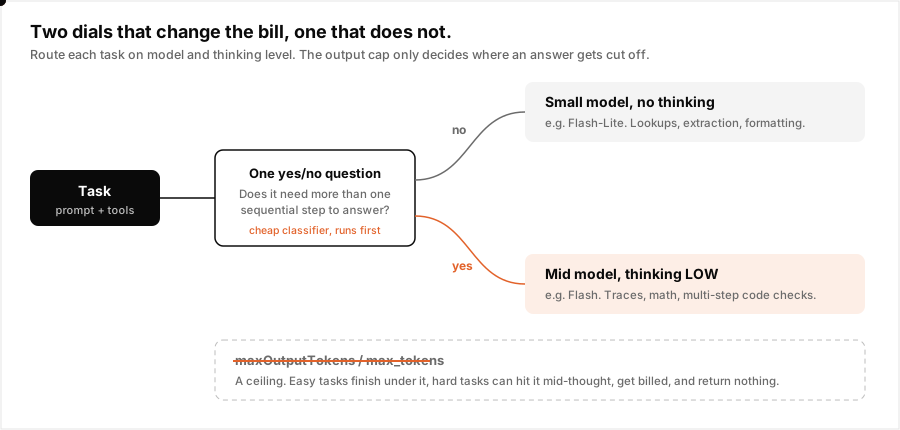
What Google tested.
Sergio Villani of Google Cloud ran 50 auto-graded coding-agent questions against live Gemini models, with difficulty labeled by hand. The configurations were Gemini 3.8 Flash at default and low thinking, Gemini 3.5 Flash-Lite with no thinking, and Gemini 3.1 Pro. A Jev decision model routed between them. The findings worth taking with you:
| Finding | Google's result |
|---|---|
| Strongest setup without a router | 3.8 Flash on low thinking, 50 of 50 solved |
| Flash-Lite alone | Every simple task in about half a second, 6 of 25 hard tasks missed |
| 300-token output cap, easy tasks | Thinking tokens almost unchanged, slightly higher cost |
| 300-token output cap, hard tasks | 7 of 25 broken: 6 empty, 1 wrong |
| Keyword and length heuristic router | 93.8% on its 16 dev tasks, 70.6% on 34 unseen ones |
| Classifier router with one atomic yes/no question | 34 of 34 held out, 48 of 50 overall |
| Router: Flash-Lite, escalate to Flash on low | 50 of 50 |
Google is clear about the limits: one run per setup, 50 prompts, simple grading. On prompts this short, the router's saving over low thinking everywhere was small per task. The post's central line is the part that generalizes: "If your cheap option doesn't actually make the model think less on easy tasks, no router can save you money."
Two other details are easy to miss. The first attempt at a classifier asked one broad simple-or-complex question and sent almost everything to simple. It started working when the question became one atomic factor: does this task need more than one sequential calculation, simulation step, or deduction? The second is that the keyword heuristic lost 23 points on unseen tasks. Rules written on your dev set tend to fit your dev set.
Why the cap does not cut thinking.
maxOutputTokens on Gemini, max_output_tokens on OpenAI, and max_tokens on Anthropic all do the same thing: stop generation once the count is reached. Thinking tokens count toward that limit on all three, and they bill at the output rate. Google's pricing page labels every Gemini output price "including thinking tokens."
A model does not plan its reasoning around the ceiling. An easy task that needs 120 thinking tokens uses 120 under a 300 cap and 120 under a 4,096 cap. The cap never binds, so it never saves anything. A hard task that needs 1,800 tokens hits the ceiling mid-thought. You are billed for everything it generated before the cut, and you get either no answer or a rushed one.
| Provider | The ceiling | The setting that changes thinking | What hitting the ceiling looks like |
|---|---|---|---|
| Google Gemini | maxOutputTokens | thinkingLevel (for example LOW) | Truncated or empty answer, thinking still billed |
| OpenAI | max_output_tokens | reasoning.effort | Response marked incomplete, reasoning tokens still billed |
| Anthropic Claude | max_tokens | effort, or a thinking budget below max_tokens | stop_reason of max_tokens, output billed up to the cut |
We compared the three thinking settings themselves in The Overthinking Tax. This post covers the setting people reach for instead, and why it doesn't work.
The model.
We simulated 100,000 tasks at Gemini list prices: 3.8 Flash at $0.75 input and $3.75 output per million tokens, 3.5 Flash-Lite at $0.30 and $2.50. Every prompt is 1,200 tokens. Sixty percent of tasks are easy and forty percent are hard. Thinking tokens per task are drawn from a lognormal distribution:
| Assumption | Easy task | Hard task |
|---|---|---|
| Thinking, default level (median) | 120 | 1,800 |
| Thinking, low level (median) | 60 | 700 |
| Visible answer | 60 | 300 |
| Flash-Lite success, no thinking | 98% | 76% |
| Flash success, either level | 100% | 100% |
The 76% figure mirrors Google's 6 of 25 missed hard tasks. Our hard tasks think longer than Google's short prompts did, so in our model the 300-token cap truncates every hard task instead of 28% of them. That is the point of the exercise: the longer your hard tasks reason, the more the cap breaks.
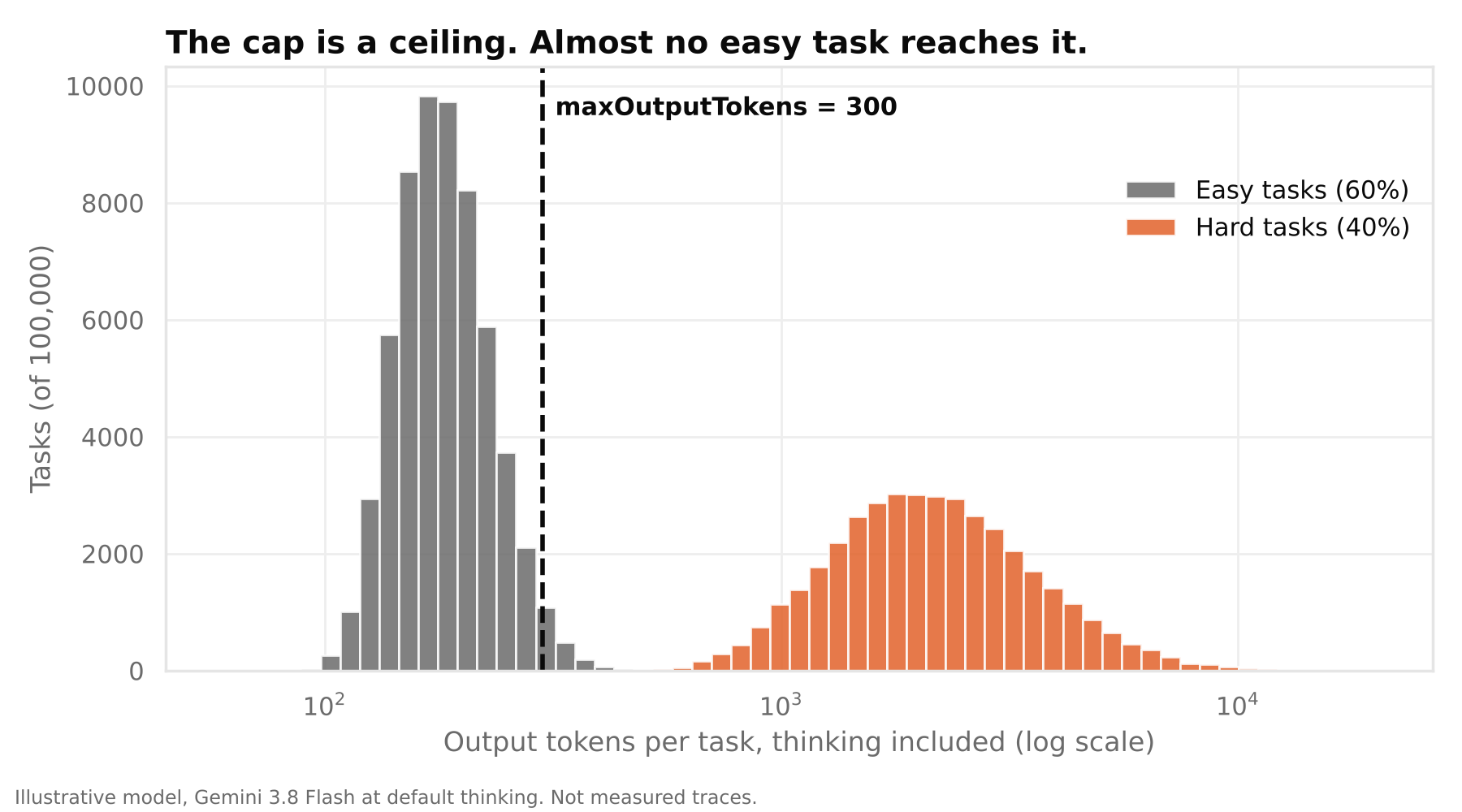
Nearly the whole easy distribution sits below the line. Only 2.3% of easy tasks reach the cap. All of the hard ones do.
Results.
| Configuration | $ per 1,000 tasks | Solved | $ per 1,000 solved |
|---|---|---|---|
| Flash, default thinking | $5.00 | 100.0% | $5.00 |
| Flash, default + 300 cap, retry on truncation | $5.84 | 100.0% | $5.84 |
| Flash, default + 300 cap, no retry | $1.77 | 58.5% | $3.03 |
| Flash, low thinking | $2.91 | 100.0% | $2.91 |
| Flash-Lite only | $0.75 | 89.1% | $0.84 |
| Classifier router (96% accurate): Lite or Flash-low | $2.34 | 98.5% | $2.38 |
| Cascade: Lite, cheap check, escalate to Flash-low | $1.36 | 98.9% | $1.38 |
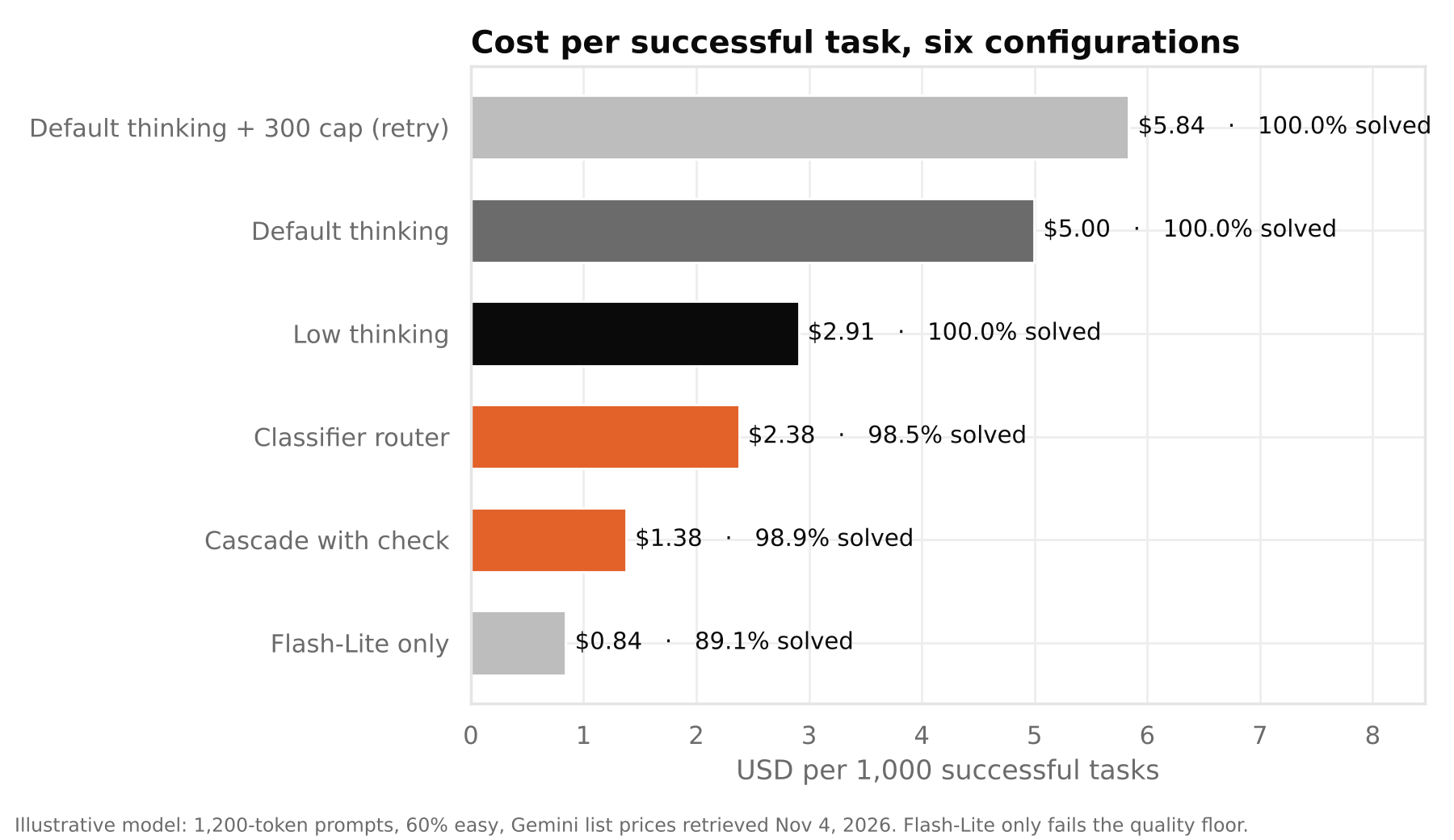
The cap with retries costs 17% more than doing nothing. Every truncated attempt is billed and then paid for again in the retry. Without a retry, the capped run looks cheap per attempt because 41.5% of tasks return nothing.
Turning thinking down is the first saving, and it needs no router. Low thinking cuts the bill 42% against default thinking, with every task still solved in this model, and Google saw the same thing with real calls. That makes it the baseline any router has to beat, which was Google's recommendation too.
Routing on both settings goes further. The classifier router lands at $2.38 per 1,000 solved, 18% under low thinking everywhere. A cascade that tries Flash-Lite first, runs a cheap check, and escalates the failures lands at $1.38, 53% under low thinking and 72% under the default. The cost is quality. The router misses 1.5% of tasks through misroutes, and the cascade misses 1.1%, which are the failures its check didn't catch.
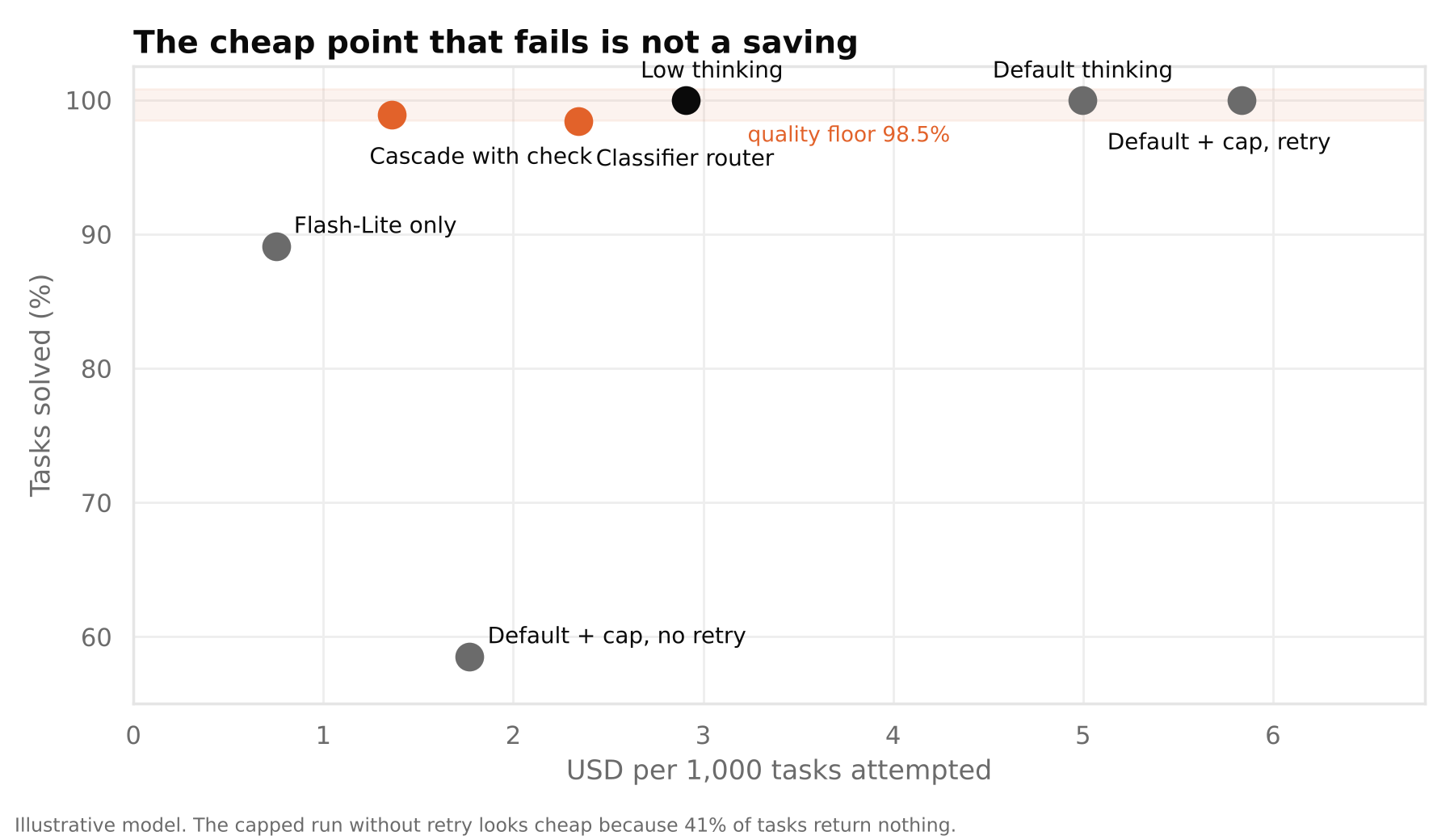
Cost per success can still mislead. Flash-Lite alone has the lowest cost per solved task, at $0.84, and solves only 89.1%. A wrong answer that ships has a cost the metric does not count. So set a quality floor first, then compare cost per success among the configurations that clear it.
The recipe.
- Delete the cap as a cost control. Keep a generous
max_tokensas a safety limit against runaway generation. Stop expecting it to save money. - Set the thinking level explicitly. Most call sites run at the vendor default. Measure low against default on a few hundred real tasks. If quality holds, take the saving.
- Ask one atomic routing question. "Does this need more than one sequential step?" beats "is this hard?" A broad question collapses to one answer, and keyword rules overfit. See Jev, Laya, GLiNER: Beaten by len() for how cheap routing signals behave on held-out data.
- Route on model and thinking level together. Easy tasks go to a small model with no thinking. Multi-step tasks go to a mid model with low thinking. Reserve the frontier model and high thinking for what fails both.
- Check before you escalate. A schema match, a unit test, or a cited span catches most cheap-model failures for a fraction of a call. A failure nobody detects is the expensive kind. See The Retry Tax.
- Keep long context on one model. Google points out that a cache belongs to one model. Switching models every turn on a long agent session either needs two caches or loses the cache discount. Route short, self-contained tasks, and keep long, context-heavy turns where their cache lives.
- Report cost per successful task, with a quality floor. Log thinking tokens, truncations (
stop_reason,finish_reason, incomplete status), retries, and escalations. Divide spend by tasks that passed your check.
The model, in code.
import numpy as np
rng = np.random.default_rng(7)
PRICE = {"flash": (0.75, 3.75), "lite": (0.30, 2.50)}   # $/M in, out (thinking included)
N, IN = 100_000, 1200
easy = rng.random(N) < 0.6
ln = lambda med, s: rng.lognormal(np.log(med), s, N)
think_def = np.where(easy, ln(120, 0.35), ln(1800, 0.6))
think_low = np.where(easy, ln(60, 0.5), ln(700, 0.6))
ans = np.where(easy, 60, 300)
lite_ok = rng.random(N) < np.where(easy, 0.98, 0.76)
usd = lambda m, i, o: (i * PRICE[m][0] + o * PRICE[m][1]) / 1e6

default = usd("flash", IN, think_def + ans)
trunc = think_def + ans > 300                          # the 300-token cap binds
capped_retry = np.where(trunc, usd("flash", IN, 300) + default, default)
low = usd("flash", IN, think_low + ans)
lite = usd("lite", IN, ans)
caught = ~lite_ok & (rng.random(N) < 0.90)              # check catches 90% of misses
cascade = lite + usd("lite", 300, 20) + np.where(caught, low, 0)

for name, c, ok in [("default", default, 1.0), ("cap+retry", capped_retry, 1.0),
                    ("low", low, 1.0), ("cascade", cascade, (lite_ok | caught).mean())]:
    print(f"{name:10s} ${c.mean()*1000:.2f}/1k tasks  solved {ok:.1%}")
This prints about $5.00, $5.84, $2.91, and $1.36 per 1,000 tasks. Replace the medians, the 60/40 split, and the success rates with numbers from your own logs before you trust any of it.
Where Nadir fits.
This is the decision a routing layer is built to make on every request. Nadir's gateway takes model="auto" and picks a model per request by classifying the task. Its observe mode records what it would have routed without changing anything, so you can see your own easy-to-hard mix, and what thinking and truncation cost you, before you switch any traffic. Savings depend on your workload, and nothing in this post forecasts yours.
Get a free key, or estimate savings from your current spend.
Limitations.
- Synthetic tasks with assumed token distributions and success rates. Google's real run used 50 prompts.
- Quality is a pass or fail coin per configuration. Real failures are correlated, so a task one model misses is more likely to be one the next model also misses.
- The check call is assumed cheap, and assumed to catch 90% of cheap-model failures with no false alarms.
- No caching, no latency, and no Gemini 3.8 Flash price change. Flash list prices double on January 1, 2027, which roughly doubles every Flash row above. See Gemini 3.8 Flash doubles in January.
Sources: [Google for Developers Blog, "Cost per task: using cheap classifiers to route across Gemini models and thinking levels," Sergio Villani, November 3, 2026](https://developers.googleblog.com/cost-per-task-using-cheap-classifiers-to-route-across-gemini-models-and-thinking-levels/). [Google AI Studio, Gemini API pricing](https://aistudio.google.com/docs/pricing), retrieved November 4, 2026: Gemini 3.8 Flash $0.75 input and $3.75 output per million tokens through December 31, 2026, Gemini 3.5 Flash-Lite $0.30 and $2.50, output prices including thinking tokens. [OpenAI, Reasoning models](https://platform.openai.com/docs/guides/reasoning). [Claude API Docs, Effort](https://platform.claude.com/docs/en/build-with-claude/effort). Charts were generated with Python and seaborn from the illustrative model above.