On November 17, Business Insider reported an internal memo from Salesforce COO Miguel Milano: "Starting this month, every role has a monthly token budget." Non-technical sellers get $100 a month. Technical sales staff get $1,000. Technical people in customer success and professional services get $500. Some employees had spent "thousands of dollars per month on tokens" the quarter before. Twelve days earlier, IBM CEO Arvind Krishna wrote in Fortune that "rationing is a decision to underfund what you have already chosen."
Both are right, and the memo already contains the line that reconciles them: match the model to the task. This post puts the Salesforce budgets next to the other company caps, prices one illustrative month for a seller and a technical SE, and shows which rung of Salesforce's approval ladder each one lands on with three different setups. It ends with rolebudget.py, about 90 lines that run role budgets with a pooled team ledger, a downshift that never switches models mid-thread, and reports that show only team totals where works councils require it.
The Salesforce details are from [MLQ's summary of Business Insider's report](https://mlq.ai/news/salesforce-caps-employees-ai-spending-after-some-ran-up-thousands-of-dollars-a-month-in-tokens/) and [Startup Fortune](https://startupfortune.com/salesforce-caps-employee-ai-spending-after-token-bills-hit-thousands-a-month/). We have not seen the memo. A Salesforce spokesperson told reporters the company "does not have companywide individual token budgets" and leaves usage to team leaders. Krishna's quotes are from his [Fortune op-ed](https://fortune.com/2026/11/05/ibm-arvind-krishna-ai-inference-cost-curve-rationing-tokens/) of November 5. Dollar figures for workloads are our illustrative model, not Salesforce or customer data.
What the memo sets.
| Group (as reported) | Technical roles | Non-technical roles |
|---|---|---|
| Sales | $1,000 / month | $100 / month |
| Customer Success | $500 / month | $100 / month |
| Professional Services and Forward Deployed Engineering | $500 / month | $100 / month |
Four mechanics matter more than the numbers:
- Budgets pool by team, "similar to T&E". A manager owns the team total, so one person's spike can be covered by teammates who spent less.
- The ceiling is soft. Near 100%, an internal Slack app called DevBar alerts the employee and their manager.
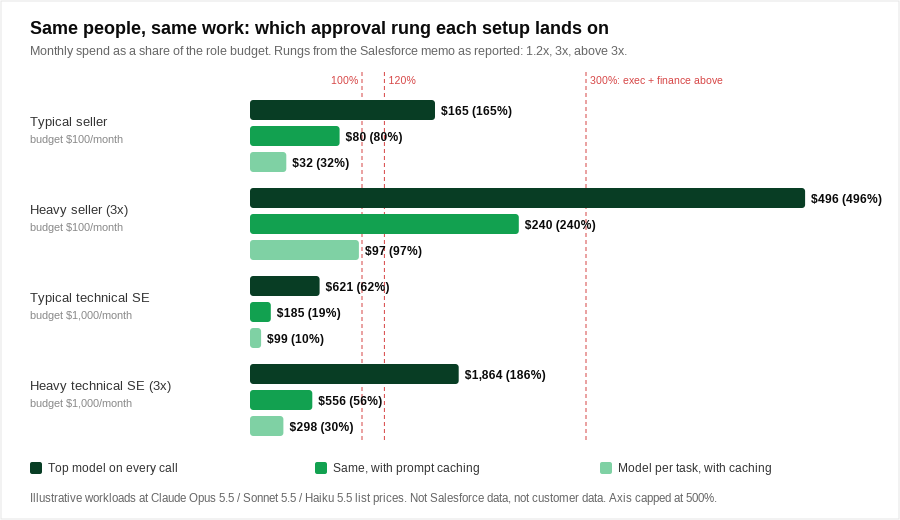
- Overage climbs an approval ladder. Up to 20% over, once: second-line manager. Up to 3x: third-line manager plus an ROI case, good for 90 days. Above 3x: the group president with finance, reviewed monthly.
- In works-council countries, leaders see only pooled team spend, not individual usage.
The memo also says what to use: Slackbot and Gemini for drafting, summarizing and research, because "even heavy users typically spend <$100 per month." A pilot team "was operating well under budget by month two with no drop in output."
Everyone has a cap now. Salesforce's has job titles.
| Company | Cap as reported | Unit | Keyed on |
|---|---|---|---|
| Salesforce | $100 to $1,000 | Month | Role, pooled by team |
| Coinbase | $500 to $5,000 | Week | Role and seniority |
| JPMorgan | $2,000 for some engineers using Claude Code | Month | Tool |
| Uber | $1,500 per AI coding tool | Month | Tool |
| Apple | $300 cut to $200, $100 planned for some teams | Day | Team |
Coinbase and JPMorgan via Business Insider as summarized by MLQ. Uber and Apple as covered in [The $100 Day](/blog/hundred-dollar-day-apple-ai-budget-cap-coding-agent-cost).
Role budgets are an improvement on a flat cap: a seller and a solutions engineer do different work. A role budget still assumes cost follows the person, and our model below says it mostly follows the setup.
Same people, same work, three bills.
We modeled one month for two people at Claude list prices (Opus 5.5 at $4/$20, Sonnet 5.5 at $2/$10, Haiku 5.5 at $0.10/$0.50 per million tokens).
- Seller: 400 drafts and summaries (6K tokens in, 800 out), 40 account-research agent runs (25 turns, about 30K tokens of context and 1.2K out per turn) and 20 proposals (40K in, 5K out).
- Technical SE: the same mix, plus 20 proof-of-concept builds with a coding agent (80 turns, 70K context, 1.5K out per turn).
- Heavy user: three times the volume.
Each is priced three ways: the top model on every call with no prompt caching, the same with caching (80% of a research turn and 90% of a build turn read from cache), and a model per task with caching (Haiku for drafts, Sonnet for research and proposals, Opus for one build turn in five).
| Person | Top model, no cache | With caching | Model per task, with caching |
|---|---|---|---|
| Typical seller ($100) | $165, third-line + ROI | $80, within | $32, within |
| Heavy seller ($100) | $496, exec + finance | $240, third-line + ROI | $97, within |
| Typical technical SE ($1,000) | $621, within | $185, within | $99, within |
| Heavy technical SE ($1,000) | $1,864, third-line + ROI | $556, within | $298, within |
Illustrative workloads, list prices, cache writes at 1.25x input. Not Salesforce data and not customer data.
Three things fall out of it:
- The ladder measures the configuration. The heavy seller goes from exec-and-finance review to inside budget with no change in work. The rung tells you how the tools are set up, not how productive the person is.
- Research agents are the seller's bill. On the top model with no cache, the 40 research runs are $144 of the typical seller's $165. Drafts, the thing people picture when they say "sellers use AI", are $16. That fits Startup Fortune's report that the heaviest users were in sales and customer success, not engineering.
- A typical technical SE with a sensible setup spends what a seller is allowed. $99 against a $1,000 budget. The 10x gap between the two budgets is real headroom only if someone sets the defaults.
Pooling helps only when the pool isn't already empty.
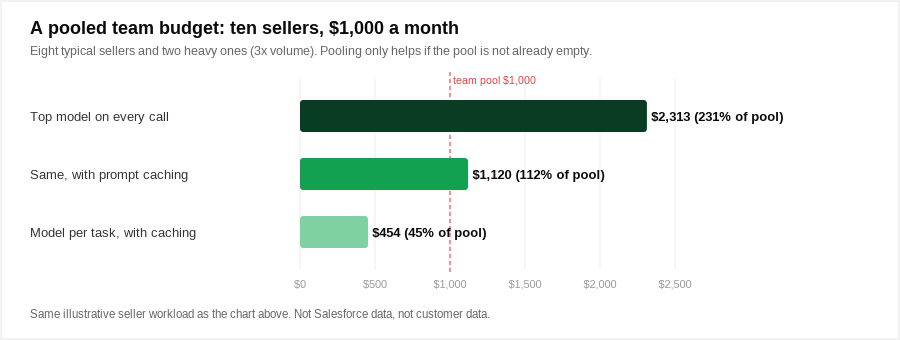
T&E-style pooling is a good idea: it lets a manager absorb one big week without paperwork. But in our ten-seller team the pool is overdrawn 2.3x when every call goes to the top model, so pooling only moves the escalation from one person to the manager. With a model per task, the same ten people use 45% of the pool, and the two heavy users fit inside the slack the other eight leave.
Krishna's point, in budget terms.
Krishna's op-ed argues against rationing and for lowering the unit cost: agents "read roughly 600 words for every one they write," IBM found 98% of what its agents needed already in cache, and the goal is "the highest token yield." Those are the same two levers in our table, caching and the model choice, and between them they move every person in the model under budget.
So the disagreement is about order, not direction. A cap without a cheaper default only rations. A cheaper default without a cap still lets an agent loop run all weekend. Set the defaults first, then cap what's left. The memo's pilot result, well under budget "with no drop in output", is what that order looks like.
Tutorial: role budgets that downshift before they refuse.
rolebudget.py keeps a monthly ledger per person, pools it by team, alerts at 100%, maps overage onto the ladder, and picks the model once, at session start. That last rule matters. The prompt cache belongs to one model, so switching a live agent thread to a cheaper model re-sends the whole prefix at full price. We worked that through in Your Router Is Fighting Your Prompt Cache.
"""rolebudget.py: monthly token budgets by role, pooled per team,
with a session-start downshift, the approval ladder, and pooled-only reports."""
import json, urllib.request
from collections import defaultdict
from dataclasses import dataclass

ROLE_BUDGET = {"seller": 100, "seller_technical": 1000,
               "cs": 100, "cs_technical": 500}            # USD per month
LADDER = [(1.0, "none"), (1.2, "second_line"),             # one-time, up to 20% over
          (3.0, "third_line_roi_90d"), (float("inf"), "exec_and_finance")]
MENU = {  # task class -> models, cheapest first
    "draft":    ["claude-haiku-5-5"],
    "research": ["claude-sonnet-5-5", "claude-opus-5-5"],
    "build":    ["claude-sonnet-5-5", "claude-opus-5-5"],
}
DOWNSHIFT_AT = 0.8              # from 80% of a personal budget, new sessions start cheap
POOLED_ONLY = {"DE", "FR", "NL"}  # works-council countries: team totals only
SLACK_WEBHOOK = None            # set to your incoming-webhook URL

@dataclass
class Person:
    id: str; team: str; role: str; manager: str; country: str

spend = defaultdict(float)      # person id -> USD this month
people: dict[str, Person] = {}

def share(p: Person) -> float:
    return spend[p.id] / ROLE_BUDGET[p.role]

def pool(team: str) -> tuple[float, float]:
    members = [p for p in people.values() if p.team == team]
    return (sum(spend[p.id] for p in members),
            sum(ROLE_BUDGET[p.role] for p in members))

def start_session(pid: str, task: str, hard: bool = False) -> str:
    """Pick the model once, at session start. Never switch mid-thread:
    the prompt cache is per model, so a switch re-sends the whole prefix."""
    p, menu = people[pid], MENU[task]
    if hard and share(p) < DOWNSHIFT_AT:
        return menu[-1]
    return menu[0]

def rung(p: Person) -> str:
    s = share(p)
    return next(name for limit, name in LADDER if s <= limit)

def record(pid: str, usd: float) -> None:
    p = people[pid]
    before = share(p)
    spend[pid] += usd
    if before < 1.0 <= share(p):
        used, cap = pool(p.team)
        alert(p, f"{p.id} reached 100% of the {p.role} budget. "
                 f"Team pool: ${used:,.0f} of ${cap:,.0f}. "
                 f"Approval needed past here: {rung(p)}.")

def alert(p: Person, text: str) -> None:
    print("ALERT ->", p.id, "+", p.manager, ":", text)
    if SLACK_WEBHOOK:
        body = json.dumps({"text": text}).encode()
        urllib.request.urlopen(urllib.request.Request(
            SLACK_WEBHOOK, body, {"Content-Type": "application/json"}))

def team_report(team: str) -> dict:
    members = [p for p in people.values() if p.team == team]
    used, cap = pool(team)
    report = {"team": team, "spent": round(used, 2), "pool": cap,
              "over_budget": sum(share(p) > 1 for p in members)}
    if not any(p.country in POOLED_ONLY for p in members):
        report["people"] = {p.id: {"spent": round(spend[p.id], 2),
                                   "rung": rung(p)} for p in members}
    return report
A quick run:
from rolebudget import *
for i in range(10):
    people[f"s{i}"] = Person(f"s{i}", "emea-sales", "seller", "mgr1", "UK")

start_session("s0", "research", hard=True)   # 'claude-opus-5-5'
record("s0", 85)                              # 85% of $100
start_session("s0", "research", hard=True)   # 'claude-sonnet-5-5': downshifted
record("s0", 20)
# ALERT -> s0 + mgr1 : s0 reached 100% of the seller budget.
#   Team pool: $105 of $1,000. Approval needed past here: second_line.
Four design choices, each one deliberate:
- Downshift before you refuse. From 80%, new sessions start on the cheapest model in their class, even when the caller asked for the hard one. The person keeps working. A refusal is the last rung, not the first.
- Alert once, at the crossing.
recordfires only when spend crosses 100%, not on every request after it, so the manager gets one message instead of a channel full of them. The message carries the pool balance, because under T&E pooling that is the number the manager decides on. - Count dollars from the usage block. Feed
recordthe cost of each response from the provider's usage fields (input, cached input, cache writes and output, including thinking). A ledger that counts requests or estimates tokens from string length will disagree with the invoice. - Privacy is structural. If any member of a team is in a works-council country,
team_reportdrops the per-person rows entirely. Check your own works-council and data-protection obligations before you ship this. The country list here is an example, not legal advice.
The cheapest change is still the one before any of this: set the default model per task class, and turn on prompt caching for agent workflows. In our model those two lines did more than the whole ladder.
Where Nadir fits.
Nadir makes the per-request part of this: which model each request gets from the menu you configure, chosen before the call so a thread is not moved after it starts. It does not set your budgets and it does not change provider prices.
- Attribution. Send
X-Nadir-Tags: team:emea-sales,role:sellerand an opaqueX-Nadir-End-Userid with each request, and the dashboard rolls spend up by org, team and member. That is the ledgerrolebudget.pyneeds, without parsing invoices. The full tagging scheme is in the chargeback tutorial. - Governance policies. A policy binds to a person, not a key, and folds org, team and user rules so the most restrictive wins. It can set a model allowlist and a price ceiling (nothing pricier than a Haiku-class or Sonnet-class model). In downgrade mode, a request for a model outside the policy runs on an allowed one instead of failing.
- Report mode first. A new policy can run in report mode, where it records what it would have done and changes no model and no bill. Preview replays your recent usage against it before you enforce anything.
- Daily budgets refuse, they don't switch. Nadir's governance budget is daily, and once it is spent requests get a 402. It does not move a live thread to a cheaper model, for the cache reason above. Monthly role budgets and the approval ladder stay in your ledger or finance tool.
Nadir costs $0.002 per request, with the first 50 a month free, and no markup on model spend: your provider bills you directly. We publish no universal savings rate, because it depends on your traffic. If most of a team's requests need the top model, routing will not move its rung, and we wrote down those cases in When LLM Routing Does Not Help.
More on caps: The $100 Day prices a coding-agent day under Apple's cap, and Budget Bankruptcy paces a router so it doesn't spend a month's budget in the first week.
Conclusion.
Salesforce gave every role a monthly token budget: $100 for sellers, $500 to $1,000 for technical roles, pooled by team, with a Slack alert near 100% and an approval ladder at 1.2x, 3x and above. In our illustrative model, the same seller's month costs $165, $80 or $32 depending only on the model choice and caching, which is the difference between a third-line ROI case and using a third of the budget. Krishna is right that rationing alone underfunds the work, and the memo is right that budgets need owners. Set the model per task and turn on caching first. Then give each role a budget, pool it by team, downshift new sessions at 80%, and keep the ladder for the work that really needs more.