On August 10, 2026, Anthropic cancelled a price increase it had told everyone was coming.
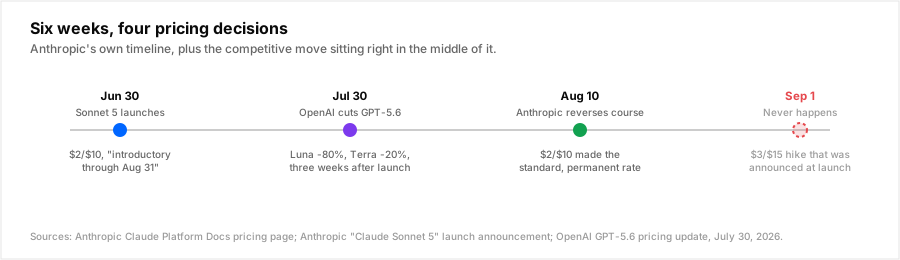
Claude Sonnet 5 launched on June 30, 2026 at $2 per million input tokens and $10 per million output — a third off the $3/$15 rate every Sonnet release had carried since Sonnet 4. Source: Anthropic, "Introducing Claude Sonnet 5" Anthropic was explicit that the discount was temporary: standard pricing of $3/$15 was scheduled to take effect September 1. We wrote about that countdown on July 25, when it was 37 days out and looked like the kind of pricing cliff worth planning around.
It didn't happen. Anthropic's own pricing documentation now carries this note: "The $2/$10 per million input/output token pricing for Claude Sonnet 5, announced at launch as introductory pricing through August 31, 2026, is now the standard price. The previously scheduled increase to $3/$15 per million input/output tokens on September 1, 2026 will not occur." Source: Anthropic, Claude Platform Docs, Pricing The cliff got cancelled seven weeks after it was announced, three weeks before it would have taken effect.
Pricing figures in this post are drawn from Anthropic's and OpenAI's published documentation as of August 2026, not from proprietary Nadir usage data.
We need to correct our own chart.
Our July post ran a three-bar chart: Sonnet 4.6 at $0.060 for a representative task, Sonnet 5 at $0.052 through August, and a red bar at $0.078 from September 1 — a 30% jump back over the old rate, driven by the discount expiring on top of Sonnet 5's newer tokenizer producing roughly 30% more tokens for the same text. Source: Anthropic, Claude Platform Docs, Pricing That red bar was accurate given what Anthropic had published at the time. It's also the one part of that post that turned out to be wrong, because the input it depended on changed.
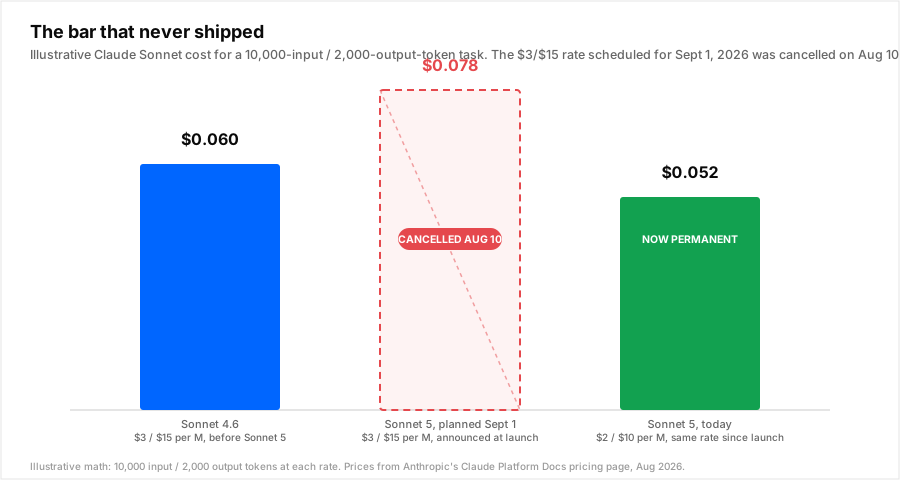
That's the whole story in one image: the bar that should be there today, by Anthropic's own July roadmap, simply isn't. Teams that read the July pricing page and planned for $0.078 in September are budgeting, and possibly routing traffic, against a number that no longer exists.
The reversal didn't happen in a vacuum.
Six weeks separate the launch discount from the cancellation, and one of the loudest pricing moves of the year happened right in the middle of them. On July 30, OpenAI cut GPT-5.6 Luna's price 80% (from $1/$6 to $0.20/$1.20 per million input/output tokens) and Terra's 20%, just three weeks after that model family launched. Source: CNBC, "OpenAI cuts prices for two of its GPT-5.6 AI models as companies grow sensitive to costs," Jul 30, 2026; Source: OpenAI, "Advancing the price-performance frontier with GPT-5.6" OpenAI framed it as passing on efficiency gains; reporting at the time pointed at the same pressure showing up everywhere else in 2026: a more cost-sensitive enterprise buyer and competition from cheaper Chinese labs squeezing the exact price band Sonnet 5 competes in. Source: CNBC, Jul 30, 2026
Zoom out further and the pattern holds. The frontier token price index sits at roughly 12 as of late August 2026, 88% below its March 2023 baseline, even as frontier-tier models keep getting more capable. Source: BenchLM.ai, "LLM API Pricing Trends & Updates," Aug 2026 We've covered the mechanism behind that divergence before: flagship prices hold or climb while the mid-tier, the band Sonnet 5 and GPT-5.6 Terra actually sell into, keeps getting undercut. DeepSeek's pricing has been dragging that same band down all year. Raising Sonnet 5 by 50% into that environment, on the day the discount happened to expire, would have been the opposite move from where the rest of the market was heading. Cancelling it wasn't generosity. It was reading the room.
This isn't the first time the menu moved mid-year, either.
Sonnet 5's price staying put is one instance of a pattern this blog keeps documenting under different names. Anthropic closed Priority Tier to new capacity commitments in 2026 after selling it as a purchasable option earlier in the year. Three different providers renamed or restructured a model within the same 72-hour window in July, breaking anything that matched on a model string. Now a headline price change, announced explicitly and seven weeks in advance, got cancelled with three weeks of runway left. None of these required a single line of model behavior to change. Every one of them broke something for a team that had encoded the old assumption somewhere static: a price constant in a cost dashboard, a routing rule set to flip models on September 1, a budget forecast built on the $0.078 number.
What actually ships this week.
- Grep your codebase and spreadsheets for hardcoded per-token prices. If a number like
0.000002or$2/$10appears anywhere outside a config value fetched at request time, it's a liability the day a provider changes its mind, not just the day a model gets deprecated. - Undo any pre-emptive routing changes made in anticipation of the September hike. If a team shifted default traffic off Sonnet 5 ahead of time, expecting a 50% jump, that traffic is now paying a different model's price for no reason — the thing it was trying to avoid never happened.
- Treat a provider's pricing page as a diffable source, not a one-time read. A calendar reminder for "the day the discount ends" is exactly the kind of static assumption that just got proven wrong; a scheduled check against the actual page catches a reversal like this one before a forecast or a routing rule quietly goes stale.
- Separate "the model changed" from "the price changed" in your monitoring. Model routing tends to get watched for capability drift; price is easy to assume is fixed between deprecations. 2026 has shown pricing moves on a shorter, less predictable cycle than model releases do.
Where this fits next to routing.
A cost dashboard or router that hardcodes $2/$10 for Sonnet 5 was correct on June 30, wrong-in-a-good-way through August, and would have been wrong-in-a-bad-way from September 1 if the cliff had landed as scheduled — three different truths for one constant, inside ten weeks. Nadir prices every routed request against live provider rates instead of a number someone typed into a config file once, so a reversal like Anthropic's on August 10 changes what a request costs on the savings dashboard automatically, the same day it takes effect, without anyone needing to notice the docs page changed. The same mechanism that keeps a routing decision from committing to a model based on a stale price is the one that keeps a cost forecast from committing to a rate that a provider is free to walk back with a documentation edit.
Conclusion.
Nothing about Claude Sonnet 5 changed on August 10 except the number written on Anthropic's pricing page, and even that number went back to what it already was. The interesting part isn't the model, it's the seven-week round trip: a price change announced with unusual specificity, three weeks of a competitor's own price cuts landing in between, and a reversal that undid the entire premise of a "cliff" post this blog published a month earlier. Teams that hardcoded September 1 into a spreadsheet, a routing rule, or a budget model are now holding a number Anthropic itself says will never be charged. The fix isn't predicting the next reversal correctly. It's not needing to, because the system pricing your requests reads the actual rate instead of remembering one.
Data in this post reflects Anthropic's and OpenAI's published pricing documentation as of August 2026, not measured production traces or proprietary Nadir customer data. Sources: [Anthropic, "Introducing Claude Sonnet 5"](https://www.anthropic.com/news/claude-sonnet-5). [Anthropic, Claude Platform Docs, Pricing](https://platform.claude.com/docs/en/about-claude/pricing). [CNBC, "OpenAI cuts prices for two of its GPT-5.6 AI models as companies grow sensitive to costs," Jul 30, 2026](https://www.cnbc.com/2026/07/30/open-ai-price-cut-gpt.html). [OpenAI, "Advancing the price-performance frontier with GPT-5.6"](https://openai.com/index/advancing-the-price-performance-frontier-with-gpt-5-6/). [BenchLM.ai, "LLM API Pricing Trends & Updates," Aug 2026](https://benchlm.ai/llm-pricing-trends).