The average price of a million tokens hit a 2026 low the same week a two-year price anchor said it was raising its rates.
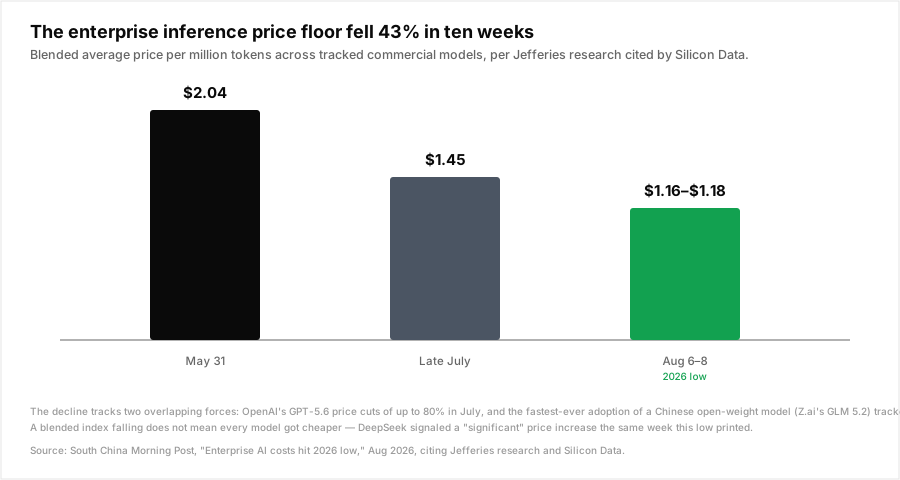
Jefferies research, cited by Silicon Data and reported by the South China Morning Post, put the blended average inference price across tracked commercial models at $1.16 to $1.18 per million tokens between August 6 and 8, 2026 — the lowest reading of the year. Source: South China Morning Post, "Enterprise AI costs hit 2026 low driven by price wars, Chinese open-source models," Aug 2026 That average was $1.45 in late July and $2.04 on May 31 — a 43% drop in ten weeks. Two things moved it: OpenAI cutting GPT-5.6 Luna's price up to 80% in late July, which we covered when it collided with Anthropic's own pricing reversal, and a wave of Chinese open-weight models undercutting the entire mid-tier at once.
Pricing and adoption figures in this post are drawn from Jefferies/Silicon Data, CNBC, Vercel, OpenRouter, and Artificial Analysis reporting as of August 2026, not from proprietary Nadir usage data.
Four models did most of the work.
DeepSeek, Qwen, GLM, and Kimi stopped being the "budget alternative" sometime in the first half of 2026 and became a default option enterprises actually route production traffic to. Source: CNBC, "Chinese AI models are gaining ground with U.S. companies as OpenAI, Anthropic costs surge," Jul 7, 2026 Open-weight Chinese models now run 60% to 90% cheaper than comparable Anthropic and OpenAI offerings, per that reporting, and the adoption curve backs it up: Z.ai's GLM 5.2 saw the fastest ramp of any model Vercel has tracked, with daily token volume growing roughly 27x and the number of customers running it growing roughly 80x in its first full week live. Coinbase, Airbnb, and Microsoft are named among the enterprises shifting some workloads to Chinese models. Source: CNBC, Jul 7, 2026
The pricing spread across that group is wide, not uniform:
| Model | Input / output per 1M tokens | Artificial Analysis Intelligence Index (v4.1) |
|---|---|---|
| DeepSeek V4 Flash | $0.14 / $0.28 | 44 (DeepSeek V4 Pro) |
| GLM 5.2 | $0.447 / $3.31 (OpenRouter weighted avg) | 51 — #1 open-weight |
| Kimi K3 | ~$3 / $15 | 43 (Kimi K2.6) |
| Nemotron 3 Ultra | — | 48 |
| MiniMax M3 | ~1/10th of Opus 4.8 | 44 |
Source: OpenRouter, "The Open Weight Models that Matter," Jun 2026 A single-digit spread on a benchmark index sits next to a 20x spread in listed price. "Chinese open-weight model" is not one line item; it's a menu, and the cheapest entry on it isn't the one that's winning adoption fastest.
The irony: the model that anchored the floor is the one raising its price.
We wrote in early August that Bloomberg reported DeepSeek planned a "significant" price increase across its services on August 6, 2026 — the same week Jefferies recorded the 2026-low blended average. Those two facts aren't a contradiction, they're the story. DeepSeek spent roughly two years being the cost floor almost everyone routed simple traffic to by default. The blended index kept falling anyway, because GLM 5.2, Qwen, Kimi, and OpenAI's own cuts moved in to undercut it. A market where the previous floor can raise its price and the average still hits a new low isn't a market with one cheap option — it's a market with enough cheap options that no single vendor's move sets the price anymore.
That's the part a routing table built around "send simple traffic to DeepSeek" misses. It was correct advice in May. By August, it was one input among five viable ones, and the cheapest of the five wasn't the same model it was ten weeks earlier.
"Good enough" is doing the load-bearing work in every one of these headlines.
The CNBC framing is explicit: when a task doesn't need the best model, teams are starting to route it to the cheapest one that's good enough, and Chinese open-weight models are winning that trade on price. Source: CNBC, Jul 7, 2026 The problem is that "good enough" is a per-request judgment, and the price war is being adopted as a fleet-wide policy. When we ran MiniMax M3 against Claude Opus 4.8 on 198 real prompts, the cheaper model matched Opus within a point on 70% of them — and came back clearly worse on 27%, rising to 58% on the hardest prompts. A team that reads "60-90% cheaper" and flips a default model for all traffic is buying that whole distribution, tail included, on every request, whether or not that specific request could tolerate it.
The fix isn't refusing the discount. Every number in this post is real, and a 43% drop in the price floor is worth routing toward. It's not making the decision once, in a routing table, for every request that will ever come after. A verifier that checks the specific answer that came back before deciding whether to escalate is the mechanism that lets a fleet actually capture a cheap model's price without inheriting its tail on the requests that needed better.
What actually ships this week.
- Re-run whatever routing table sent "simple" traffic to a specific cheap model three months ago. The cheapest viable option has already changed at least once since spring; a hardcoded model name in a routing rule is stale the moment a new entrant undercuts it.
- Separate the pricing decision from the quality decision. "This model is 80% cheaper" and "this model is good enough for this request" are different claims backed by different evidence — don't let the first one silently answer the second.
- Check the specific answer, not the average benchmark score. A model that's within a point of frontier quality on 70% of a benchmark set is still clearly worse on the other 30% — verify the individual response your specific request got back, not the model's reputation.
- Track savings against dynamic pricing, not a number from the vendor comparison you did last quarter. DeepSeek's own pricing has moved in both directions within a year; a dashboard reading last quarter's rate card is already wrong.
Where this fits next to routing.
A price war this fast produces a genuinely good outcome — the floor is 43% lower than it was in May — and a genuinely bad failure mode: fleets that adopt the cheapest model as policy instead of as one option scored per request. Nadir treats every new entrant, DeepSeek, GLM, Kimi, Qwen, the next one after them, as another option in the routing pool, priced against live rates instead of a card someone checked once, and gated by a verifier that decides per request whether the cheap answer that came back is the one to keep. The savings dashboard reflects the actual rate in effect the day a request runs, the same way it already absorbed Anthropic cancelling a scheduled Sonnet 5 price hike without anyone touching a config file.
Conclusion.
Ten weeks, a 43% drop in the blended price floor, and the model that built that floor announcing it's moving off it in the same week the low printed. None of that is noise — it's what a genuinely competitive market for tokens looks like in real time, and it's worth capturing. The mistake is capturing it once, as a policy, instead of on every request, as a decision. The floor will keep moving. The question that actually needs answering isn't which model is cheapest this week. It's whether the answer a cheap model just gave was good enough for the request that asked it.
Sources: [South China Morning Post, "Enterprise AI costs hit 2026 low driven by price wars, Chinese open-source models," Aug 2026](https://www.scmp.com/tech/tech-trends/article/3363549/enterprise-ai-costs-hit-2026-low-driven-price-wars-chinese-open-source-models-research). [CNBC, "Chinese AI models are gaining ground with U.S. companies as OpenAI, Anthropic costs surge," Jul 7, 2026](https://www.cnbc.com/2026/07/07/chinese-ai-models-costs-us-openai-anthropic.html). [OpenRouter, "The Open Weight Models that Matter: June 2026"](https://openrouter.ai/blog/insights/the-open-weight-models-that-matter-june-2026/).